
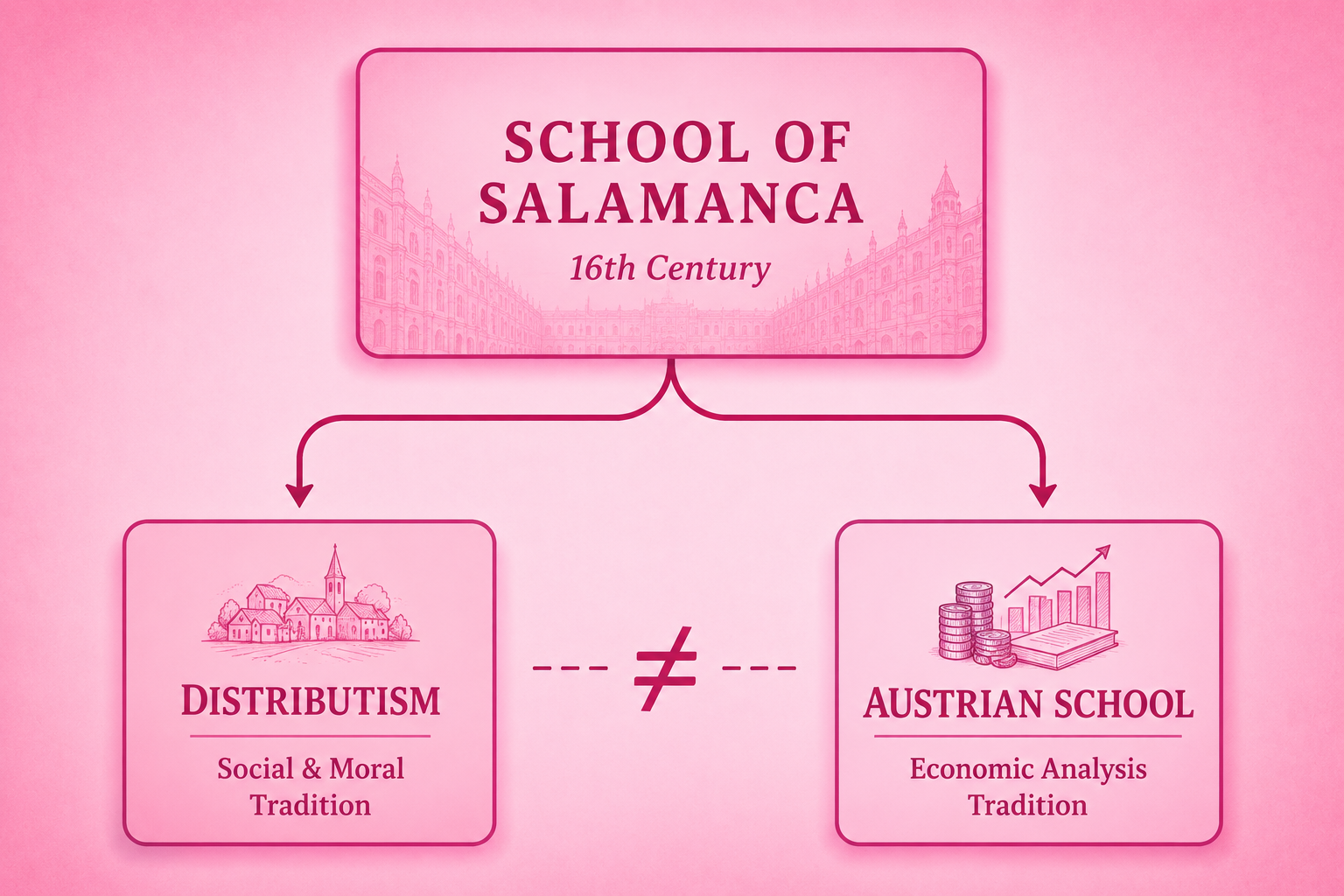
Distributism and Austrian economics share an intellectual source in the School of Salamanca, but they do not belong to the same lineage. The Salamancans combined Aristotelian-Thomistic natural law with sophisticated analyses of private property, prices, money, scarcity, and exchange. Because their thought contained both a moral philosophy of economic life and an emerging theory of market processes, later traditions could inherit different parts of it.
Distributism followed Salamanca’s moral, theological, and social direction. Through Catholic social teaching and thinkers such as Hilaire Belloc and G. K. Chesterton, it emphasized the common good, family independence, local communities, and the widespread ownership of productive property. It does not merely defend private property in the abstract; it argues that property should be sufficiently distributed to prevent society from being divided between a small owning class and a propertyless majority.
Austrian economics followed Salamanca’s analytical direction. The scholastics’ discussions of subjective valuation, common market estimation, monetary expansion, scarcity, and entrepreneurship anticipated themes later developed by Cantillon, Turgot, Menger, Böhm-Bawerk, Mises, and Rothbard. Austrian economics concentrated on explaining how prices, production, and social coordination emerge from purposeful individual action, rather than prescribing a particular distribution of property.
The two traditions therefore have a common ancestor but separate genealogies. Distributism develops Salamanca’s social teleology and Catholic conception of the common good; Austrian economics develops its subjectivist and causal analysis of the market. They may agree on private property, opposition to socialism, and criticism of monopoly, but they ask different questions and arrive at different social doctrines. Salamanca is their point of intersection, not evidence that they form a single lineage.
Leave a Reply