
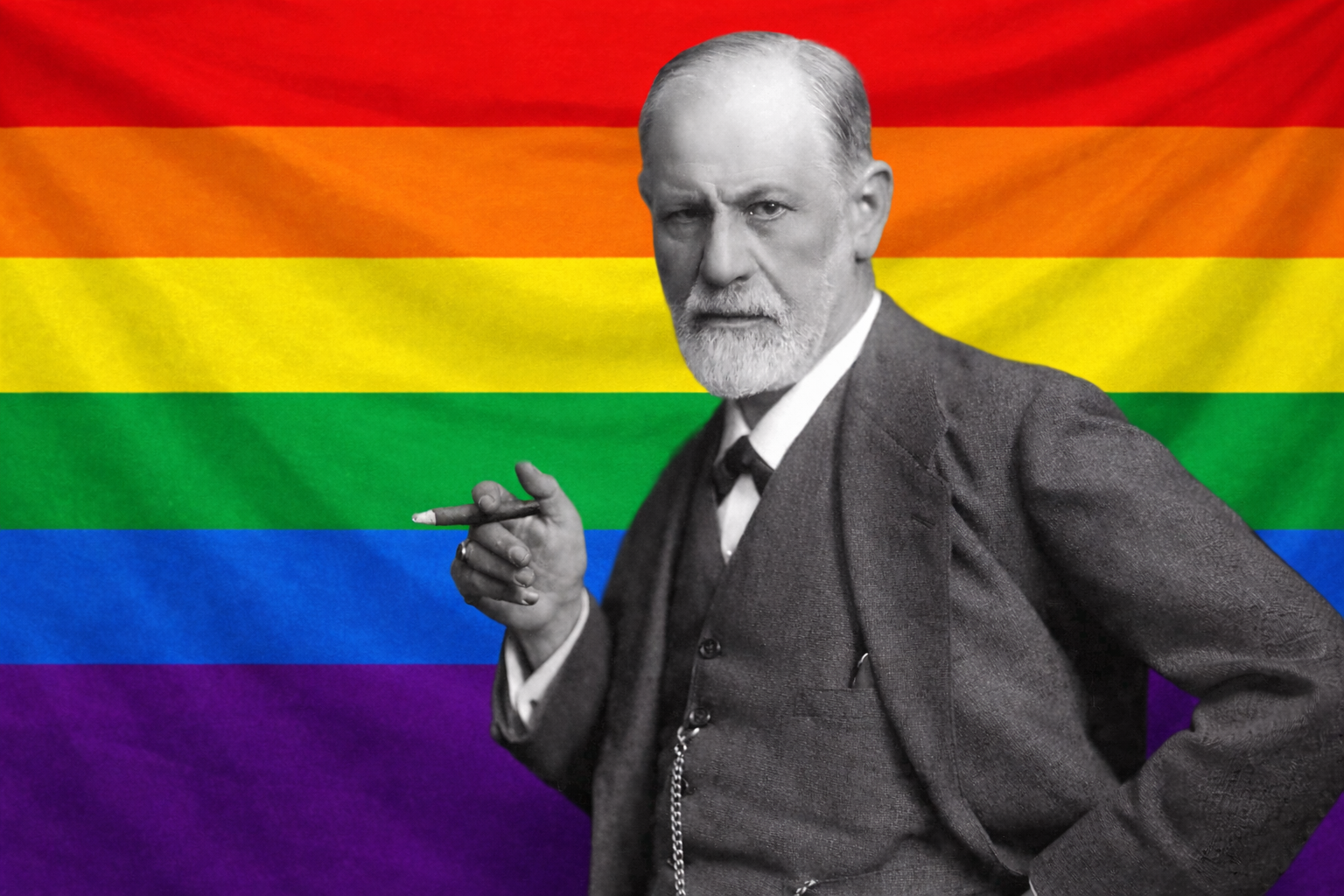
Freud’s theory of narcissism is built on a strictly intrapsychic model of the human being. For Freud, narcissism is the movement of libido away from external objects and back onto the self. In its secondary form, this process is often linked to developmental fixations and plays a role in shaping what he calls “narcissistic object choice,” where the individual seeks to love what resembles himself. Within this framework, Freud even connects certain sexual orientations to narcissistic structures, interpreting them as extensions of self-directed libido.
His position becomes clearer when looking directly at his treatment of homosexuality. He explicitly associates male homosexuality with what he calls “narcissistic object choice,” where the individual does not direct desire toward a fundamentally different other, but toward someone who resembles himself. In this framework, the homosexual subject seeks a mirror of his own image—an extension of the ego—rather than a complementary opposite. Freud interprets this as a displacement of libido that first returns to the self (secondary narcissism) and is then projected outward onto a similar object. Although he did not classify homosexuality strictly as a disease, he nonetheless theorized it as a deviation rooted in narcissistic fixation, often linked to early developmental dynamics such as identification with the self and defense against anxiety.
This approach, however, suffers from a fundamental limitation: it abstracts human behavior from its biological and evolutionary context. It risks pathologizing what may in fact be functional.
From an evolutionary perspective, male and female behaviors are not merely psychological expressions but reproductive strategies shaped by natural selection. Female hypergamy—the tendency to select partners with superior genes, status, or resources—can be understood as an adaptive mechanism aimed at maximizing offspring quality. This is not narcissism in the Freudian sense. It is not a withdrawal into the self, but a directional strategy toward selecting the best possible external partner. At the level of the species, such selection contributes to the gradual improvement of physical and cognitive traits over generations.
Within this framework, what is often labeled “female narcissism,” sometimes described in psychology as “covert” or “vulnerable” narcissism, can be reinterpreted. Rather than a true narcissistic withdrawal, it may reflect an intensified or dysfunctional expression of hypergamy. Behaviors such as manipulation, status sensitivity, or instrumentalization of others are not necessarily rooted in self-love, but in strategic partner selection. The other is not loved as an object in the Freudian sense, but used as a means toward reproductive or social ends.
By contrast, male reproductive strategy has historically been oriented toward genetic dispersion, resulting in a tendency toward polygamy. In this context, male narcissism—especially in its pathological form (Narcissistic Personality Disorder)—can be understood as a signaling mechanism. Inflated self-image, dominance behavior, and status-seeking function as tools in male-male competition. Narcissism here becomes a strategy to increase attractiveness, visibility, and access to multiple partners. It is not merely a disorder, but an exaggerated survival mechanism within a competitive environment.
Empirical data partially supports this asymmetry. A majority of diagnosed cases of Narcissistic Personality Disorder are male, with estimates ranging between roughly 50% and 75%. Lifetime prevalence is also higher among men than women. This suggests that pathological narcissism aligns more closely with male competitive dynamics than with a universal psychological structure.
The myth of Narcissus itself reinforces this interpretation. Narcissus is not a woman, but a young man who falls in love with his own reflection. This pure form of self-directed desire closely mirrors Freud’s definition of narcissism. The symbolic origin of the concept is thus inherently male, centered on self-image rather than relational strategy.
Freud’s related concepts—auto-eroticism and primary narcissism—further illustrate his framework. In early development, libido is not yet directed toward external objects but satisfied through the body itself. This idea can be extended to certain contemporary expressions of identity and embodiment, where the body becomes the primary object of desire. While Freud did not address modern phenomena such as androgynous aesthetics or identity-based self-eroticization (like femboys or twinks, for exemple), his concept of auto-eroticism provides a lens through which such tendencies can be interpreted as intensified investments in self-image.
Yet these interpretations remain confined to symbolic and clinical explanations. They do not account for why such patterns persist across populations and time.
Evolutionary theory provides that missing layer. Human behavior is shaped not only by internal psychic conflicts but by selective pressures. Female hypergamy and male polygamy naturally produce asymmetries: in an unregulated environment, a small percentage of high-status men would monopolize access to a large share of women, leaving many men reproductively excluded. This imbalance generates frustration, instability, and potential social conflict.
Social institutions—particularly religion—can be understood as mechanisms designed to regulate these dynamics. By enforcing monogamy, they constrain both hypergamy and polygamy, redistributing access to partners more evenly across the population. This reduces social tension, stabilizes communities, and facilitates governance. Sexual morality, in this sense, operates as a form of social technology aimed at containing biologically rooted drives.
The sexual revolution has weakened many of these constraints, allowing underlying strategies to re-emerge more openly. This does not represent a regression in a simplistic sense, but a shift toward less regulated expression of evolved behaviors. What is often described today as a rise in narcissism may instead reflect the visible manifestation of these strategies in a context where traditional norms have eroded.
Narcissism, therefore, should not be understood as a single, uniform phenomenon. It takes different forms depending on sex, social context, and evolutionary pressures. Where Freud sees a universal psychic mechanism centered on the self, an evolutionary perspective reveals differentiated strategies oriented toward reproduction, status, and survival.
Pathological narcissism itself can be interpreted as an extreme extension of these strategies—no longer adaptive, but still rooted in underlying biological logic. It is not simply a disorder detached from function, but a distortion of mechanisms that once served a purpose.
In this light, Freudian theory appears incomplete. It captures certain internal dynamics but fails to situate them within the broader framework of human evolution. A full understanding of narcissism requires moving beyond Freud, integrating psychological insight with biological reality, and recognizing that what appears pathological may, in origin, be strategic.
Leave a Reply