
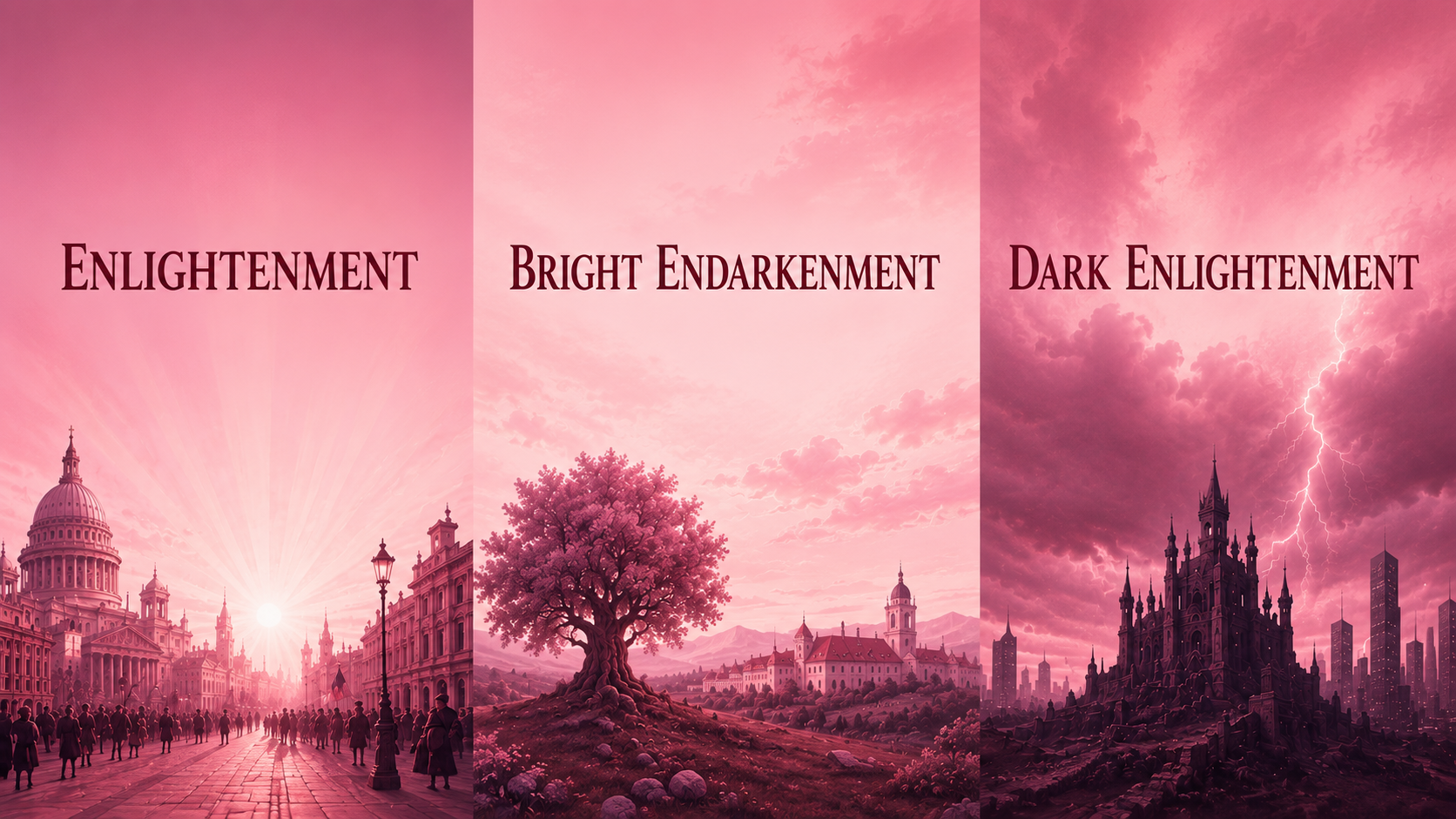
Modern political philosophy is commonly understood as a debate within the intellectual legacy of the Enlightenment. Liberalism, socialism, constitutional democracy, secular humanism, positivism, and many forms of modern conservatism define themselves in relation to the transformation that began in seventeenth- and eighteenth-century Europe. More recently, another current has emerged in opposition to this inheritance. The Dark Enlightenment, associated principally with Curtis Yarvin, Nick Land, and the broader neo-reactionary movement, rejects democracy, egalitarianism, and the universalist assumptions that have shaped modern political thought. Contemporary debate is therefore often presented as a choice between two rival visions of modernity: the liberal optimism of the Enlightenment and the hierarchical realism of the Dark Enlightenment.
This opposition is genuine but incomplete. Both traditions remain enclosed within the philosophical revolution that followed the gradual abandonment of the Aristotelian-Thomistic conception of reality. They disagree about democracy, equality, and the proper organization of political authority, yet both tend to conceive society as an object of conscious construction. The Enlightenment entrusts this task to universal reason, constitutional institutions, scientific administration, and democratic legitimacy. The Dark Enlightenment entrusts it to executives, sovereign proprietors, monarchs, or hierarchical elites. Their dispute concerns the identity of the architect more than the legitimacy of political architecture itself.
The Bright Endarkenment begins elsewhere. It is neither an extension of the Enlightenment nor a conventional reaction against it. It proposes the recovery of an older intellectual tradition whose premises precede those shared by both modern camps. Its lineage extends from Aristotle and Thomas Aquinas through the School of Salamanca, Richard Cantillon, Carl Menger, Eugen von Böhm-Bawerk, Ludwig von Mises, and Murray Rothbard. These thinkers did not agree on every question, but they shared a conviction that reality possesses an intelligible order independent of political will, ideological construction, or historical fashion. The task of reason is to discover that order rather than create it.
The expression Bright Endarkenment is deliberately paradoxical because it challenges the historical symbolism established by the Enlightenment. The Enlightenment portrayed itself as an age of light emerging from centuries of intellectual darkness. Medieval philosophy, scholasticism, Aristotelian metaphysics, and natural-law reasoning were consequently treated as remnants of a world modern civilization had overcome. This metaphor became so powerful that it shaped not only political history but the history of philosophy itself. Intellectual progress came to be identified with emancipation from the Aristotelian worldview.
The Bright Endarkenment reverses this narrative. It argues that what the Enlightenment dismissed as darkness was, in important respects, an intellectually unified civilization whose philosophical foundations were richer than modern accounts often admit. This claim should not be confused with nostalgia for medieval institutions or hostility toward modern scientific discoveries. The argument concerns the architecture of knowledge. Before the Enlightenment, Aristotelian philosophy supplied a common framework within which the sciences could recognize both their differences and their unity. Logic, metaphysics, ethics, natural philosophy, jurisprudence, politics, and the study of human action belonged to an ordered intellectual whole because reality itself was understood as coherent.
Aristotle’s influence extended far beyond the conclusions of ancient Greek science. His concepts of substance, form, matter, act, potency, causality, and finality provided a vocabulary through which diverse fields of inquiry could communicate. Natural philosophy investigated motion and change. Ethics examined human flourishing. Politics studied communities and constitutions. Logic disciplined reasoning. Metaphysics considered being as being and the principles presupposed by every particular science. These disciplines differed according to their objects, but they were not conceived as isolated enterprises governed by mutually incompatible accounts of reality. They participated in a common philosophical vision according to which the world’s intelligibility preceded every scientific investigation.
The Bright Endarkenment seeks neither to restore ancient physics nor to deny the achievements of modern science. Aristotle’s empirical conclusions in astronomy, mechanics, or biology may be corrected without abandoning the metaphysical principles that make scientific inquiry intelligible. The central question is not whether modern physics is superior to ancient cosmology, but whether science requires a philosophical account of causality, nature, truth, and intelligibility. Modern scientific success encouraged the belief that metaphysics had become unnecessary and that the empirical sciences could provide their own justification. The Bright Endarkenment argues that the fragmentation of knowledge began when philosophy abandoned the effort to understand the unity underlying the plurality of the sciences.
Its optimism therefore rests on a philosophical conviction rather than a prediction about history. Reality is intelligible. Human beings are capable of knowledge because the world is not an arbitrary collection of disconnected facts but an ordered whole. Truth is not created by political institutions, ideological movements, or linguistic conventions. Scientific inquiry is possible because nature possesses a structure that the intellect can progressively discover. Moral reasoning is possible because human beings possess a real nature and characteristic powers. Economics is possible because purposeful action exhibits stable and comprehensible forms. Political philosophy is possible because justice cannot be reduced to the preferences of those who exercise power.
This confidence distinguishes the Bright Endarkenment from both historical determinism and historical pessimism. It does not maintain that civilization inevitably progresses toward liberty, nor does it assume that decline is irreversible. History contains advances, regressions, losses, and recoveries. Intellectual traditions may disappear for centuries before being rediscovered. Philosophical errors may dominate civilizations without abolishing the possibility of truth. Human reason is finite and fallible, but fallibility does not entail scepticism. Error presupposes truth, just as meaningful disagreement presupposes a reality about which people may disagree.
The Enlightenment deserves admiration for many of its achievements. It challenged arbitrary privilege, defended freedom of inquiry, encouraged scientific investigation, opposed various forms of absolutism, and contributed to constitutional government, religious toleration, and civil liberties. A serious criticism of the Enlightenment cannot deny these accomplishments or romanticize every institution that preceded it. Such an approach would replace history with mythology.
The philosophical problem lies in the changing meaning of reason. Within the Aristotelian tradition, reason is both receptive and active. It apprehends an intelligible order that exists independently of the knowing subject. Truth consists in the conformity of intellect and reality. The mind does not legislate the structure of being but participates intellectually in an order that precedes it.
Modern philosophy gradually altered this relationship. Francis Bacon reoriented scientific inquiry toward prediction, utility, and technological mastery. René Descartes sought certainty by beginning with the thinking subject rather than being itself. Political philosophy increasingly imagined individuals as conceptually prior to their social relationships and presented political society as the product of contract rather than as something developing within communities ordered toward common goods. Across several disciplines, the emphasis shifted from participation in reality to its reconstruction through autonomous reason.
This development was neither uniform nor reducible to a single formula. Locke differed profoundly from Rousseau, Hume from Kant, and Adam Smith from Voltaire. Nevertheless, they participated in a wider movement whose direction became increasingly visible. Reason came to be understood less as the discovery of an intelligible world and more as the principle through which that world was interpreted, organized, and justified. Society likewise appeared less as an order emerging through human association than as an artefact capable of rational redesign.
The achievements of mathematical physics reinforced this tendency. Because quantitative methods proved extraordinarily successful in explaining physical phenomena, many philosophers concluded that every genuine science should imitate mechanics and mathematics. Human action, political institutions, and economic life increasingly came to be studied through models emphasizing measurement, prediction, optimization, and formal calculation. The sciences retained their institutional plurality while losing a common philosophical account of their relation to one another.
The consequence was fragmentation rather than integration. Each discipline developed its own methods, assumptions, and vocabulary, often without reference to an account of reality capable of explaining how these different forms of inquiry concern the same world. Metaphysics came to be regarded as speculative, ethics as subjective, political philosophy as ideological, theology as private belief, and economics as an increasingly mathematical discipline detached from broader reflection on human action. The success of specialization concealed the disappearance of the framework that had once unified knowledge.
The deepest error of the Enlightenment was therefore not confidence in reason but the transformation of reason into rationalism. Rationality seeks to understand reality. Rationalism seeks to reconstruct it according to principles generated by reason itself. Once reason is detached from an objective order of being, institutions, customs, moral traditions, and even human nature become candidates for systematic redesign. The world ceases to be primarily something to understand and becomes something to reorganize.
This rationalism eventually produced another problem. If knowledge depends primarily on structures supplied by the autonomous subject, then the universality of those structures must itself be justified. Why should one conceptual framework possess greater validity than another? How can reason establish its authority without appealing to a reality beyond itself? The more philosophy concentrated on the knowing subject, the harder it became to explain how knowledge could avoid collapsing into subjectivity.
The movement from rationalism to relativism should therefore be understood as an internal philosophical development rather than an accidental coincidence. The Enlightenment began with great confidence in universal reason but gradually weakened the metaphysical foundations supporting that confidence. Once being ceased to function as the measure of truth, later philosophy increasingly interpreted knowledge through history, language, psychology, culture, social structures, or relations of power. Universal reason became situated reason. Objective morality yielded to moral construction. Human nature came to be treated as a product of culture rather than the foundation on which culture develops.
Modern civilization now combines these seemingly opposed tendencies. Its institutions remain rationalistic, relying on administrative expertise, scientific management, bureaucratic regulation, and technical planning. Its intellectual culture simultaneously embraces relativism concerning morality, identity, human nature, and truth. These tendencies reinforce one another. When objective reality no longer limits political reason, political institutions assume greater responsibility for defining social reality. Law no longer merely recognizes human relations but seeks to reconstruct them. Education no longer confines itself to transmitting knowledge but becomes an instrument of cultural formation. Administrative rationalism and cultural relativism are therefore not opposites; they are complementary expressions of the same separation of reason from being.
Objectivism occupies a distinctive place within this history because it vigorously rejects contemporary relativism. Ayn Rand defended objective reality, rational inquiry, capitalism, and individual liberty with remarkable consistency. For this reason, many readers regard Objectivism as a revival of Aristotelian philosophy. Nevertheless, Objectivism generally interprets Aristotle through the historical framework of the Enlightenment rather than treating the Enlightenment as a departure from Aristotle. Its account of intellectual history presents the development from Aquinas through Locke and Newton as the emancipation of reason from medieval authority, culminating in the Enlightenment. Leonard Peikoff explicitly associates Aristotle’s essential philosophical orientation with that tradition.
This interpretation reveals the difference between Objectivism and the Bright Endarkenment. Objectivism argues that the Enlightenment failed because it lacked a consistent defence of reason, capitalism, and individual rights. The Bright Endarkenment argues that the Enlightenment separated reason from the Aristotelian understanding of being and thereby encouraged the transformation of rational inquiry into rationalistic construction. Objectivism seeks a more coherent Enlightenment. The Bright Endarkenment seeks to recover the tradition from which the Enlightenment departed.
The Dark Enlightenment begins from another dissatisfaction. Rather than criticizing the Enlightenment for abandoning objective reason, it criticizes the political civilization that Enlightenment thought helped produce. Curtis Yarvin argues that democratic institutions conceal rather than eliminate concentrated power. His concept of the Cathedral describes universities, media organizations, bureaucracies, foundations, and cultural institutions as a decentralized network exercising ideological authority beyond the direct control of electoral politics. Nick Land expanded these criticisms into a wider interpretation of modernity, combining neo-reactionary political theory with technological acceleration and an impersonal account of historical development. Hans-Hermann Hoppe, although not himself a neo-reactionary thinker, influenced this environment through his criticism of democracy and his analysis of political incentives.
The Dark Enlightenment identifies genuine weaknesses in liberal democracy. Elections do not eliminate ruling elites. Administrative institutions develop interests distinct from those of the populations they govern. Cultural authority often operates independently of legislation. Claims of political neutrality frequently conceal substantive ideological commitments. These observations deserve attention because they expose important features of contemporary political life.
Nevertheless, the Dark Enlightenment remains within the philosophical horizon of modernity. It rejects democratic sovereignty only to replace it with another form of sovereignty. Where the Enlightenment entrusts political construction to democratic institutions and administrative expertise, the Dark Enlightenment entrusts it to monarchs, corporate proprietors, executives, or technological elites. Society remains an object to be consciously organized from above; only the identity of the organizer changes.
The deepest affinity between the Enlightenment and the Dark Enlightenment lies in this common premise. Both assume that political order depends on a sovereign intelligence capable of giving coherent form to society. One seeks coherence through universal reason, constitutional procedures, and democratic legitimacy. The other seeks it through hierarchy, executive authority, and concentrated ownership. Their disagreement concerns the location of sovereignty rather than the legitimacy of sovereign construction.
Both traditions therefore contain a tendency toward the totalization of political power. This does not mean that every Enlightenment thinker or every advocate of the Dark Enlightenment consciously supports totalitarian government. The argument is philosophical rather than biographical. Once society is conceived as an artefact requiring comprehensive political construction, every sphere of life becomes potentially subject to sovereign direction. Family, education, religion, property, language, economic organization, and culture cease to possess an authority independent of political design. The Enlightenment approaches this conclusion through rational administration; the Dark Enlightenment approaches it through concentrated sovereignty. Their methods differ, but both attribute to political authority a responsibility that belongs neither to governments nor to any finite intelligence.
The Bright Endarkenment rejects this premise. Political authority does not create the order of reality, establish truth, define justice, or produce the conditions of human flourishing. Reality precedes political will. The task of philosophy is not to design the world anew but to understand the order within which political life must operate. This conviction, inherited from Aristotle and transformed by Thomas Aquinas, provides the true point of departure for the Bright Endarkenment.
The recovery proposed here cannot be understood merely as a return to Aristotle in isolation. Aristotle supplied the conceptual foundations of a unified science of reality, but Thomas Aquinas integrated that inheritance into one of the most comprehensive metaphysical systems in Western thought. Aquinas did not simply preserve Aristotle. He developed his philosophy by showing that the intelligibility discovered by reason presupposes a deeper metaphysical order. Being is not a chaotic aggregate of independent objects but an ordered plurality of intelligible realities. Philosophy therefore does not compete with the empirical sciences; it clarifies the conditions under which scientific knowledge is possible.
This insight becomes especially important in relation to modern philosophy after Immanuel Kant. Kant correctly recognized that knowledge cannot be reduced to passive sensation and that the knowing subject contributes essential conditions to experience. His critical philosophy forced later thinkers to confront the relationship between the structures of the intellect and the objects known. Yet Kant concluded that reason cannot attain things as they are in themselves, but only phenomena as they appear under the conditions of human cognition. The result was a widening separation between reality and knowledge.
The Bright Endarkenment accepts Kant’s question while rejecting his conclusion. Transcendental Thomism argues that the conditions making knowledge possible do not imprison the intellect within subjective appearances. The orientation of reason toward truth presupposes that reality itself is intelligible. Human cognition is possible because intellect and being are ordered toward one another. The structures through which the mind knows are not arbitrary constructions imposed on an unknowable world but expressions of finite intelligence participating in an objective order. Transcendental reflection therefore leads not toward scepticism but toward metaphysical realism.
This approach transforms the epistemological problem. Modern philosophy often asks how an isolated subject can escape its own consciousness and reach an external world. The Aristotelian-Thomistic tradition begins from the premise that the intellect already belongs to reality. Knowledge is not the miraculous crossing of an impossible gulf between mind and world but the perfection of a natural capacity ordered toward truth. Philosophy therefore begins neither with radical doubt nor autonomous subjectivity, but with confidence that reality can be known, however incompletely, by finite rational beings.
Once this realism is restored, the unity of the sciences becomes intelligible. Each science investigates an aspect of reality through methods appropriate to its object. Physics examines material change. Biology studies living organisms. Psychology investigates the powers and operations of living and rational beings. Ethics studies human flourishing. Political philosophy examines civil society and justice. Economics investigates the universal structure of purposeful action. These disciplines remain distinct, but none is absolutely independent because all concern the same reality.
The fragmentation of modern academic life reflects more than institutional specialization. Universities frequently treat disciplines as autonomous domains possessing separate standards of truth, methods, and sometimes incompatible accounts of reality. Communication becomes difficult because no common metaphysical framework explains their unity. Specialists acquire increasingly detailed knowledge of narrow fields while understanding of the whole recedes. Genuine interdisciplinary inquiry therefore requires more than administrative collaboration; it requires a shared philosophy of being.
This intellectual inheritance did not disappear after the Middle Ages. It survived and developed within the School of Salamanca, whose theologians and jurists applied Thomistic philosophy to commerce, law, money, political authority, and international relations. Francisco de Vitoria, Domingo de Soto, Martín de Azpilcueta, Luis de Molina, and Juan de Mariana did not treat economic activity as an isolated technical subject. They understood exchange, value, property, money, and government within the wider framework of natural law and human action.
Murray Rothbard emphasized the importance of this tradition in the history of economic thought. Against the familiar narrative that economics begins with Adam Smith, Rothbard argued that many insights later associated with the Austrian School had been anticipated by the late Scholastics. Subjective valuation, market pricing, monetary theory, and limits on political authority appeared in developed or embryonic forms before The Wealth of Nations. Modern economics did not arise from nothing; it inherited and transformed an older tradition whose philosophical foundations reached through Aquinas to Aristotle.
From the School of Salamanca, this lineage continues through Richard Cantillon. Cantillon’s analysis of entrepreneurship, uncertainty, price formation, and market coordination represented a decisive advance beyond mercantilist thought. His work occupies an important intermediate position between earlier scholastic reflections on commerce and the later development of subjective economic theory, although the precise historical continuity between these traditions should not be overstated.
The decisive breakthrough came with Carl Menger, whose Principles of Economics inaugurated the Austrian School. Menger rejected both the objective cost theories inherited from classical political economy and the uncritical transfer of inappropriate methods from the natural sciences to the study of economic phenomena. Value arises not from labour embodied in goods but from the significance individuals attribute to scarce means capable of satisfying their wants. This restored the acting person to the centre of economic explanation without reducing economics to introspective psychology.
Eugen von Böhm-Bawerk developed this tradition through his analysis of capital, interest, production, and time. Economic processes unfold temporally and cannot be adequately represented by static models. Böhm-Bawerk emphasized the temporal structure of production and the role of intermediate goods in processes extending through time. Later Austrian economists developed these insights into a more explicitly heterogeneous theory of capital coordinated through prices and entrepreneurial plans.
Ludwig von Mises brought this movement to its highest methodological expression by placing economics within a broader science of human action, which he called praxeology. Human beings act purposefully by employing means to attain chosen ends. This principle is not merely a statistical generalization; it is implicit in every instance of action. For Mises and later praxeologists, even an attempt to dispute the category of purposeful action occurs through an action directed toward an end. Economics therefore rests on principles logically prior to empirical investigation while remaining concerned with the real world of human conduct.
Praxeology is often misunderstood as an attempt to replace empirical inquiry with deduction. It instead distinguishes complementary forms of knowledge. The formal structure of action may be known a priori because it is implicit in purposeful conduct. The circumstances in which action occurs remain subjects of historical, empirical, and institutional investigation. Economic theory examines the consequences of action under specified conditions, while economic history studies the situations in which those conditions arise. This distinction preserves theoretical coherence without denying the importance of experience.
Murray Rothbard extended Mises’s project while integrating it more explicitly with Aristotelian realism. Although Mises often described praxeology in Kantian language, Rothbard argued that its foundations could be better understood through a realist philosophy. Human action is not a logical construction detached from experience. It is a real feature of human life discovered through reflection on the world. Praxeological principles are evident because they describe universal features of action, not because they originate in an autonomous consciousness. Rothbard thereby reconnected Austrian economics with the realist tradition.
This connection has consequences beyond economics. If praxeology belongs within an Aristotelian philosophy of action, economics cannot remain isolated from ethics, politics, psychology, jurisprudence, and metaphysics. These disciplines investigate different dimensions of the acting person. Economics explains exchange and production. Ethics considers the goods toward which action ought to be directed. Political philosophy examines the institutional conditions of justice and peaceful cooperation. Psychology studies the cognitive and emotional powers involved in deliberation and choice. Metaphysics clarifies the nature of the beings who act. None can replace the others, yet each benefits from recognition of their common subject.
The Bright Endarkenment rejects both positivism and metaphysical reductionism. Scientific knowledge cannot dispense with philosophy, but the particular sciences should not be dissolved into metaphysics. Intellectual unity consists in recognizing an ordered plurality of disciplines within a coherent account of reality. Unity without plurality becomes dogmatism; plurality without unity becomes fragmentation. Aristotelian philosophy avoids both errors by allowing each science to retain its proper object while locating it within a common order of being.
This perspective also clarifies the limits of political authority. If reality possesses an intelligible structure independent of government, politics cannot legitimately claim competence over every aspect of life. Families, religious communities, voluntary associations, markets, universities, and local institutions possess principles arising from the nature of their activities rather than from legislation. Political authority may protect justice and the conditions under which these orders flourish, but it does not create them. Society emerges from innumerable forms of purposeful cooperation rather than from sovereign design.
Here the Bright Endarkenment converges with the Austrian understanding of spontaneous order. Markets do not function because they satisfy an abstract mathematical ideal or because history guarantees optimal outcomes. They coordinate because individuals possess dispersed knowledge unavailable to any central authority. Prices communicate information generated through exchange, while entrepreneurship coordinates production through judgment and discovery. Economic order emerges through the interaction of acting persons rather than comprehensive planning. Spontaneous order is therefore an expression of a broader principle: important forms of social coordination precede political construction.
The same principle extends beyond economics. Language develops through social interaction rather than decree. Legal customs often precede formal legislation. Moral traditions arise through inherited reflection and practical experience. Scientific communities advance through inquiry, criticism, and discovery rather than central command. Philosophy itself develops through contemplation and debate. Civilization is sustained not primarily by centralized intelligence but by the cumulative activity of persons participating in a shared world.
The Bright Endarkenment consequently rejects both constructivist optimism and reactionary pessimism. It neither imagines that society can be perfected through planning nor assumes that civilization is doomed to irreversible decline. Forgotten truths may be recovered because truth does not perish when it is neglected. Intellectual traditions may be misunderstood or abandoned, but reality remains what it is. Every generation retains the possibility of rediscovering earlier wisdom while correcting its errors.
The purpose of this book is therefore not to defend a particular historical period or add another ideology to the modern marketplace of political systems. Its aim is more fundamental. It seeks to recover a philosophical vision in which the sciences recognize their common foundation in reality, economics returns to its place within the broader study of human action, and reason resumes its proper task as the discovery rather than the construction of the intelligible order of being.
The Bright Endarkenment is neither a simple return to the past nor an escape from modernity. It seeks to recover what remains valuable in the Aristotelian tradition while incorporating the genuine achievements of later centuries. Aristotle, Aquinas, the School of Salamanca, Cantillon, Menger, Böhm-Bawerk, Mises, and Rothbard belong to a continuing conversation about reality, human action, and objective knowledge. Their insights remain relevant not because they are ancient or modern, but because the truths they investigated do not depend on historical fashion.
If the Enlightenment sought to illuminate the world by emancipating reason from tradition, the Bright Endarkenment seeks to illuminate reason by restoring its participation in reality. It does not reject the light of reason; it rejects the illusion that reason shines by its own power alone. The intellect is luminous because reality is intelligible. Philosophy therefore begins not with the sovereign will of the subject but with the recognition that truth precedes us and remains the common measure of every genuine science.
These lineages are not intended as strict chains of direct influence. They represent three reconstructed intellectual trajectories organized around competing conceptions of reason, reality, and political order.
The Enlightenment lineage may be presented as follows: Francis Bacon → René Descartes → John Locke → David Hume → classical liberalism → Karl Marx → positivism → progressivism, liberal democracy, socialism, and the modern administrative state.
The Dark Enlightenment lineage may be presented as follows: Thomas Hobbes → Joseph de Maistre → Thomas Carlyle → John Ruskin → Friedrich Nietzsche → Vilfredo Pareto → Carl Schmitt → Julius Evola → James Burnham → Hans-Hermann Hoppe → Nick Land and Curtis Yarvin.
The Bright Endarkenment lineage may be presented as follows: Aristotle → Thomas Aquinas → the School of Salamanca → Richard Cantillon → Carl Menger → Eugen von Böhm-Bawerk → Ludwig von Mises → Murray Rothbard.
Leave a Reply