
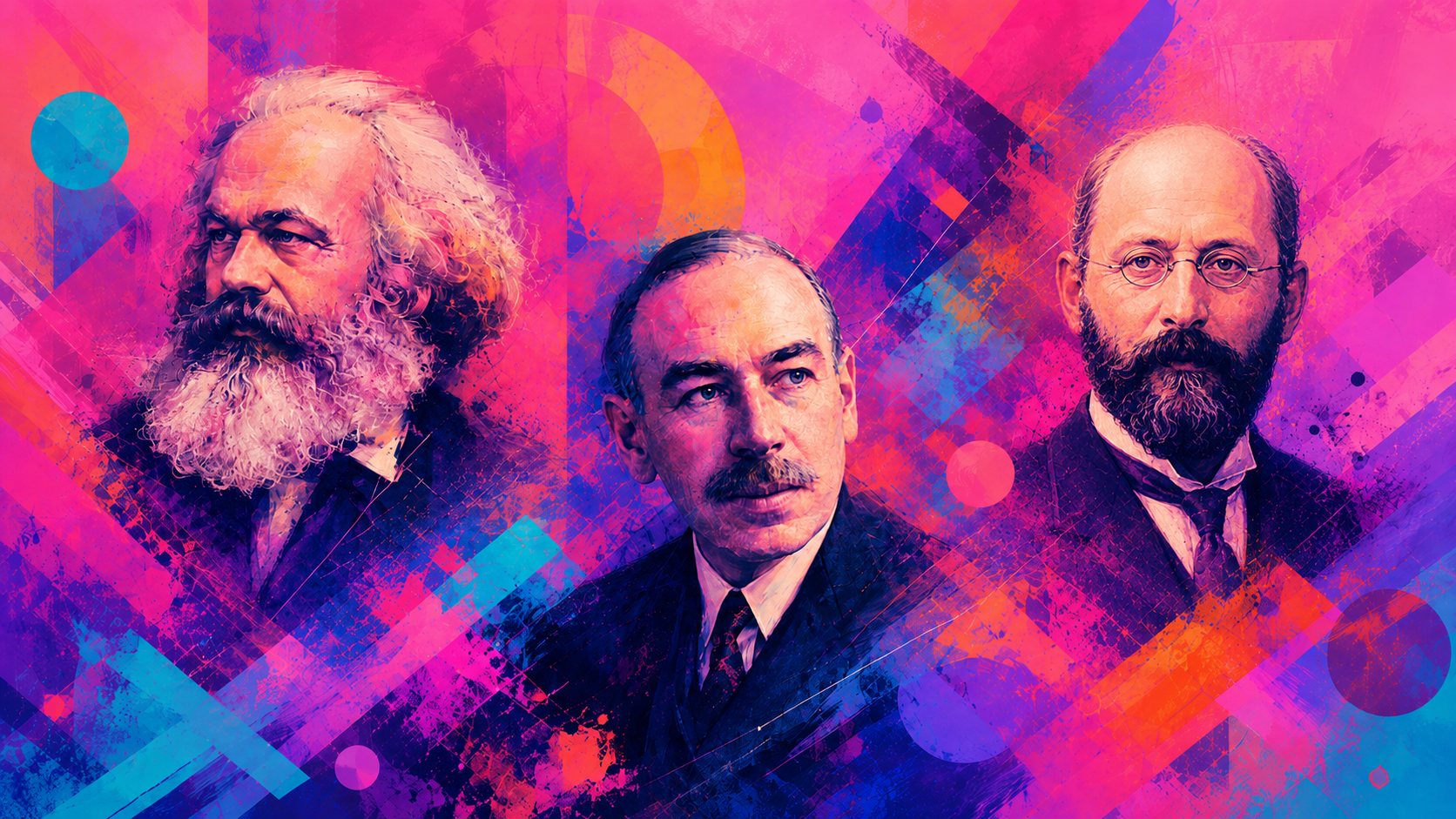
Modern social democracy is usually presented as a moderate alternative to both laissez-faire capitalism and revolutionary socialism. It is described as pragmatic, democratic, humane, and technically responsible. Historically, however, it did not appear out of nowhere. It emerged from the broader socialist movement that also produced Marxism, before gradually exchanging revolutionary language for parliamentary reform, bureaucratic administration, and economic management.
Many of the earliest and most important social-democratic parties were deeply shaped by Marxism. The German Social Democratic Party, the largest socialist party in Europe before the First World War, officially embraced a Marxist understanding of capitalism, class struggle, and the eventual transition toward socialism. Across Europe, parties connected to the Second International often accepted major parts of Marx’s analysis, even when they disagreed about tactics. Some believed capitalism had to be overthrown through revolution. Others believed socialism could be reached through elections, legislation, trade unions, and gradual reform.
The first major break came with Eduard Bernstein. Bernstein’s revisionism rejected the orthodox Marxist expectation that capitalism was on the verge of collapse. He argued that democratic institutions, parliamentary politics, and social reforms could gradually transform capitalism from within. This was not merely a tactical adjustment. It marked the beginning of social democracy’s movement away from revolutionary Marxism and toward reformist socialism.
This semantic shift matters because the word “social democrat” originally did not mean what it usually means today. Lenin himself belonged to the Russian Social Democratic Labour Party. The Bolsheviks were, in their original party identity, social democrats in the older Marxist sense of the term. But after the collapse of the Second International in 1914, when many European socialist parties supported their own national governments during the First World War, Lenin increasingly saw the label as compromised by opportunism, reformism, and social-chauvinism.
For Lenin, the old social-democratic name no longer clearly expressed revolutionary Marxism. It had become associated with parliamentary moderation and the betrayal of international socialism. This is why the Bolsheviks eventually abandoned the name “Social-Democratic” and adopted the name “Communist.” The change was not cosmetic. It marked a historical split inside socialism itself: one branch moved toward reform, parliamentarism, and administration, while the other claimed to preserve the revolutionary road to socialism.
A later and decisive policy turning point came with John Maynard Keynes.
Where Marx had diagnosed capitalism as fundamentally unstable and historically doomed, Keynes argued that capitalism could be preserved through active government management. Economic crises, unemployment, and recessions no longer had to be interpreted as proof that the market should be abolished. They could instead be treated as technical problems to be solved through fiscal policy, monetary intervention, deficit spending, public investment, and macroeconomic planning.
This was a profound transformation. The socialist party did not have to call for the immediate abolition of capitalism. It could promise to stabilize capitalism, regulate it, redistribute its gains, and manage its failures. The revolutionary activist was gradually replaced by the government economist. The barricade gave way to the bureaucracy.
Keynesianism gave social democracy something Marxism could not easily provide: a respectable academic and administrative framework for expanding state intervention without openly advocating revolution. Instead of overthrowing capitalism, governments could regulate it. Instead of abolishing markets, they could manage aggregate demand. Instead of speaking constantly in the language of class warfare, they could speak in the language of full employment, stabilization, public investment, social insurance, and economic planning.
In this sense, Keynes did not create social democracy’s break with Marxism. That break had already begun with revisionism, parliamentarism, trade-union politics, anti-Bolshevism, and the practical demands of democratic government. But Keynesianism made reformist social democracy more administratively sustainable. It gave the welfare state an economic vocabulary, a policy apparatus, and a class of experts capable of presenting intervention as technical necessity rather than ideological conquest.
The expansion of the modern welfare state increasingly depended on economists, planners, statisticians, policy analysts, central bankers, finance ministries, and civil servants. Society was no longer imagined as an order arising from voluntary exchange, spontaneous coordination, and private property. It became something to be monitored, measured, corrected, and managed.
From a Rothbardian or Austrian perspective, this was not a clean rejection of socialism. It was socialism’s bureaucratic domestication. The old revolutionary impulse survived, but its methods changed. The dream of abolishing capitalism was replaced by the permanent supervision of capitalism by the administrative state.
This development can also be understood as part of a broader intellectual lineage within political economy. Karl Marx inherited much of the analytical framework of the British classical economists, especially Adam Smith and David Ricardo, even while fiercely criticizing their conclusions. John Stuart Mill further expanded the role of government within liberal political economy, making intervention appear increasingly compatible with liberal institutions.
Seen through this lens, one can trace a broad intellectual trajectory:
Adam Smith → David Ricardo → John Stuart Mill → Karl Marx → Keynesian social democracy.
This is not to say that these thinkers were identical. Smith was not Marx. Mill was not Keynes. Keynes was not a Marxist revolutionary. But each belongs, in different ways, to a tradition that treats economic life as something that can be systematized, corrected, directed, or managed by theory and policy. Marx radicalized the classical economists’ labor theory of value and their analysis of production. Keynes, instead of adopting Marx’s revolutionary conclusions, offered governments a practical alternative: preserve capitalism while continuously expanding the administrative capacity of the state.
From an Austrian perspective, this lineage contrasts sharply with another tradition. Rather than moving from Smith to Ricardo to Marx and finally to Keynesian administration, the Austrian School can be read through a different genealogy: Aristotle, Thomas Aquinas, the late Scholastics of Salamanca, Richard Cantillon, Carl Menger, Ludwig von Mises, and Murray Rothbard. This tradition emphasizes subjective value, entrepreneurship, property and the limits of centralized knowledge.
The contrast is fundamental. In the Austrian tradition, economic order is not primarily designed from above. It emerges through action, exchange, prices, profit, loss, and entrepreneurial discovery. The market is not a machine to be managed by experts. It is a process of coordination that no central authority can fully comprehend. The more the state attempts to replace this process with macroeconomic planning, the more it distorts the signals that make rational coordination possible in the first place.
Whether one accepts this interpretation or not, it highlights an important historical reality. Social democracy evolved out of the socialist movement, and Keynesian economics did not erase that inheritance. It transformed it into a form more compatible with democratic institutions, professional bureaucracies, and the modern administrative state.
The result was not the disappearance of socialist ambition, but its institutionalization. The revolutionary was replaced by the technocrat. The manifesto was replaced by the policy paper. The street agitator was replaced by the economist with government credentials.
For Austrians, all this circus represents the evolution of socialist aspirations into a permanent system of bureaucratic state management. Social democracy became the ideology of the administrative state precisely because it learned how to pursue old ambitions through new methods: not revolution, but regulation; not expropriation, but taxation; not the abolition of capitalism, but its endless political supervision.
Leave a Reply