
Few accusations would have offended Ayn Rand more than being called a Platonist.
For Rand, Plato represented the great enemy of reason, reality, individuality, and this-worldly existence. Aristotle, by contrast, was the philosopher of logic, identity, objectivity, and the primacy of existence. Rand openly placed herself in the Aristotelian camp. She saw herself as continuing the war against mysticism, subjectivism, and every philosophy that subordinated the real world to another realm.
Marx and Lenin, from the opposite end of the political universe, also claimed to stand on the side of objective reality. Marx rejected abstract idealism in favor of production, labor, history, and material social relations. Lenin attacked philosophers who reduced the world to sensations or subjective experience. In Materialism and Empirio-Criticism, he defended the view that matter exists independently of consciousness. For Lenin, reality was not created by the mind. Science was possible because the world exists outside us and can be known.
At first glance, this creates a strange philosophical triangle. Marx, Lenin, and Rand disagreed violently on capitalism, property, individual rights, the state, morality, and the meaning of freedom. Yet all three rejected the idea that consciousness creates reality. All three despised epistemological relativism. All three believed that the world exists independently of human wishes. All three insisted that reality can be known.
But agreement on objective reality does not make one an Aristotelian.
That is the central mistake. Rand praised Aristotle. Lenin defended materialism. Marx thought he had turned Hegel right side up. Yet all three, in different ways, often remained closer to Plato in method than to Aristotle in spirit. This does not mean that they literally believed in Plato’s transcendent Forms. Marx and Lenin were materialists, and Rand was an atheist egoist who explicitly despised Platonism. The Platonism at issue here is not doctrinal. It is methodological.
Platonism, in this sense, is the temptation to begin from a sovereign abstraction and judge the world from above. The abstraction may be the Form, History, Class, Matter, the Party, Reason, the Productive Man, the Proletariat, or the Ideal Egoist. The content changes. The method remains.
Aristotle begins from the world. Plato begins from the ideal.
That is the dividing line.
Aristotle’s philosophy is rooted in observation, nature, plurality, concrete beings, practical judgment, and the study of things as they exist. He does not deny universals, but his universals are not floating in a separate world above reality. They are found in things. He does not begin political philosophy with a perfect blueprint to be imposed upon mankind. He begins from human nature, human action, habit, virtue, deliberation, friendship, and the question of what kind of life is proper to man.
This is why Aristotle is more important to the Austrian tradition than many readers realize. Long before Mises formulated praxeology as the science of human action, Aristotle had already placed action, purpose, choice, and practical reason at the center of ethics. Human beings do not simply move. They act. They deliberate. They choose means in light of ends. They seek goods, even when they are wrong about what the good really is.
At the same time, Aristotle was not an economist in the modern sense. Joseph Schumpeter was right to ask whether Aristotle contains anything like economic analysis, meaning an intellectual effort to understand economic phenomena as such. The answer is mixed. Aristotle had analytical intentions, but they did not become a developed economic science.
Aristotle’s economics remains embedded in ethics, household management, and the political community. He thinks about exchange, money, use, household order, and justice, but he does not isolate economics as an autonomous science. He does not develop a theory of market order, entrepreneurship, capital, price formation, or economic calculation. His economic thought is still framed by the polis.
This is why Aristotle could notice something important about exchange while remaining limited by the world around him. Although Aristotle discusses and even defends slavery in the Politics, he does not analyze slavery as a modern economist would: as a productive institution shaping the structure of the Greek economy. He also did not fully theorize the large-scale maritime commerce that helped make Athens powerful. His field of analysis was narrower: the household, the city, and exchanges among members of a moral and political community.
Marx understood this limitation in his own way. In Capital, Marx praises Aristotle for seeing that exchange requires some form of equality between unlike goods. But Marx argues that Aristotle could not discover the labor basis of value because Greek society rested on slavery and therefore lacked the social concept of equal human labor. In Marx’s interpretation, Aristotle had seen the problem but could not yet solve it.
Marxists who claim Aristotle, therefore, are not entirely wrong. They are wrong if they imagine Aristotle as a proto-socialist. He was not. But they are right to see in him a distant ancestor of the scientific ambition itself: the desire to understand things according to their nature, causes, forms, purposes, and internal logic. Aristotle does not merely moralize the world. He classifies it, observes it, divides it, compares it, and seeks its intelligible structure.
In that limited but important sense, Aristotle may be called the first great scientist in the history of humanity. Not because no one before him observed nature, but because Aristotle turned observation into systematic inquiry. Biology, logic, politics, ethics, metaphysics, rhetoric, psychology, and natural philosophy all become, in his hands, ordered fields of investigation. He asks what things are, how they move, why they develop, what ends they tend toward, and how they can be known.
This is why Aristotle fits so well into the Marxist self-image of “scientific socialism” against “utopian socialism.” The utopian socialist begins with an imagined ideal society and then condemns reality for failing to resemble it. The scientific socialist claims to begin instead from history, production, class relations, material conditions, and the real movement of society. Whether Marxism succeeds in this claim is another question. But the claim itself is Aristotelian in appearance: begin from the nature of the thing, not from a fantasy imposed upon it.
The irony is that Marxism invokes Aristotle most convincingly when it presents itself as anti-utopian. Aristotle gives Marxists a language of science, development, form, causality, and historical limitation. Yet this is also where Marxism becomes vulnerable to its own Platonism. It begins by claiming to study society scientifically, but it often ends by judging all concrete life from the standpoint of History, Class, and the future society to come. Aristotle gives Marxism its scientific mask. Plato gives it its revolutionary soul.
That move is revealing. Marx does not simply read Aristotle as a philosopher of nature, action, and practical judgment. He historicizes him. Aristotle becomes a stage in the development of social consciousness. The concrete philosopher is placed inside a larger historical process.
This is where the lines begin to divide.
One line moves from Aristotle to Aquinas, from Aquinas to the Scholastics, from Salamanca to Menger, from Menger to Mises, and from Mises to Rothbard. This is the aristotelian-scholastic line. It is realist, natural-law oriented, causal, deductive, and grounded in human action. It treats economics not as a blueprint for remaking mankind, but as a science of choice, exchange, property, scarcity, and social cooperation.
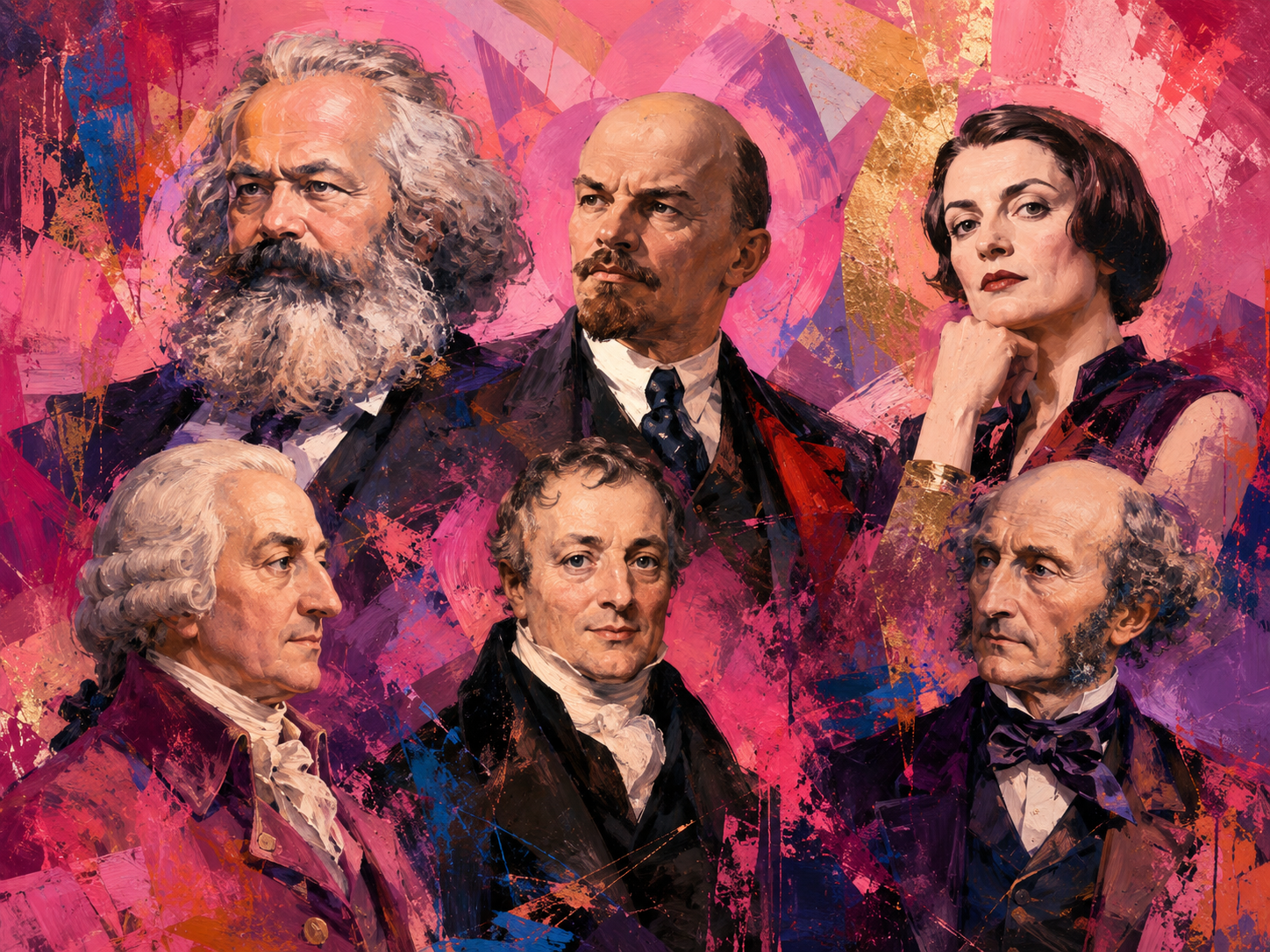
The Smithian lineage must be understood carefully. It is not that Adam Smith, David Ricardo, John Stuart Mill, Karl Marx, and Ayn Rand all taught the same doctrine. They obviously did not. Smith was not Marx, and Rand was not a socialist. The point is subtler: they belong to the same modern imagination of production, labor, capital, industry, historical progress, and the moral drama of commercial society.
Smith marks a break from the older Aristotelian-scholastic world. Aristotle had treated economic questions as subordinate to ethics, household management, and the political community. The Scholastics and later Salamanca theologians developed questions of property, contract, money, price, justice, and natural law within a broader moral and metaphysical understanding of human nature.
Smith changed the center of gravity. Political economy became less a branch of moral philosophy concerned with the proper ordering of human life, and more a science of commercial society. His world is no longer primarily the polis, the household, or natural-law jurisprudence. It is the world of labor, division of labor, accumulation, production, trade, national wealth, and the long-run tendencies of a commercial order.
This is why Smith belongs to modernity in a way Aristotle does not. Aristotle asks what kind of life is proper to man. Smith asks how commercial society generates wealth.
From an Austrian perspective, however, Smith’s achievement came with a cost. The older proto-Austrian line had already developed important insights about subjective value, exchange, entrepreneurship, money, and natural law. Smith did not create economics out of nothing. Rather, he helped create the British classical paradigm. In doing so, he shifted attention away from subjective valuation, market process, and the acting individual, and toward labor, cost of production, class income, and long-run equilibrium.
Ricardo then hardened this Smithian inheritance into a system. Political economy became more abstract, more rigid, and more centered on distribution among functional classes: wages, rent, and profit. The economy increasingly appeared as a machine of production and class shares rather than as a dynamic order of acting individuals.
James Mill and John Stuart Mill transmitted and reimposed this Ricardian framework. John Stuart Mill softened Ricardo with utilitarianism, moral concern, and social reform, but he also preserved the classical structure. The result was a modern political economy centered on production, distribution, class categories, historical development, and the possibility of rational social improvement.
Marx radicalized this world. He did not emerge primarily from Aristotle, Aquinas, Salamanca, or the natural-law tradition. He emerged from German philosophy and British classical political economy. From Smith and Ricardo he inherited labor, value, production, accumulation, class conflict, and the belief that capitalism possessed a hidden structure that could be scientifically exposed. Marx then turned classical political economy against capitalism itself.
This lineage should not be understood as a simple chain of direct influence. It is a typological lineage, not merely a bibliographical one. Rand did not need to derive her ideas consciously from Ricardo or Mill in order to belong to the same modern productionist imagination. What matters is the structure of the worldview: society is interpreted through production, class-types, industry, progress, and the moral meaning of economic activity.
This is the real meaning of the Smithian line:
Smith gives commercial society its modern economic language.
Ricardo turns that language into a hard system.
Mill moralizes, softens, and socializes it..
Marx weaponizes it.
Rand reverses it.
Rand rejects Marx’s politics, but she does not fully escape the modern productionist imagination. Her heroes are not merchants in the scholastic sense, prudent householders in the Aristotelian sense, or acting men in the Misesian sense. They are producers, industrialists, inventors, railroad builders, steel magnates, architects, and creators. Her moral universe is not built primarily around exchange as mutual benefit. It is built around production as heroic revelation.
This is why Rand fits more naturally in the Smith-Ricardo-Mill-Marx line than in the Aristotle-Aquinas-Salamanca-Menger-Mises-Rothbard line. She does not continue Marx’s economics. She inverts Marx’s moral drama. Marx divides society between exploiters and exploited. Rand divides society between producers and parasites. Marx sacralizes labor against capital. Rand sacralizes capitalistic production against collectivist looting. Both see society through a grand moral conflict between types of human beings.
Rothbard belongs to a different line. His lineage is not primarily Smithian. It is Aristotelian, scholastic, subjective-value, natural-law, and praxeological. He does not begin with production as a heroic myth. He begins with human action, scarcity, property, exchange, causality, and natural rights. He does not need the capitalist superman. He needs acting man.
So the contrast is not simply capitalism versus socialism. It is two different defenses of the market.
Rand gives a Smithian-Marxian inversion: capitalism as the moral triumph of the producer over the parasite.
Rothbard gives an Aristotelian-Misesian foundation: the free market as the social order that follows from human action, private property, voluntary exchange, and natural law.
That is why Rand, despite her love of Aristotle, often sounds more modern, more revolutionary, and more Platonic than Rothbard. She turns capitalism into an ideal image. Rothbard grounds liberty in the nature of man.
This is why the claim that Rand is an unconscious Marxist-Leninist must be handled carefully. She is not a Marxist in economics. She is not a Leninist in politics. She rejects socialism, collectivism, altruism, and the state. But she may be called “Marxist-Leninist” in a deeper cultural and literary sense: she inherits the Russian revolutionary style of total philosophy, moral certainty, militant system-building, heroic fiction, and the belief that ideas must reshape the world.
Rand fled Bolshevism, but she did not entirely escape the Bolshevik style.
This does not make her a socialist. It makes her a capitalist revolutionary.
Rand’s capitalism is not merely a defense of private property, free exchange, entrepreneurship, and voluntary cooperation. It is an epic moral revelation. Her novels do not merely show people acting in markets. They show heroic archetypes standing against metaphysical parasites. Howard Roark and John Galt are not ordinary men who reason, err, learn, cooperate, develop virtue, and refine judgment through practice. They are moral icons. They are capitalism’s positive heroes.
This is where the comparison with Soviet Socialist Realism becomes useful. Soviet literature celebrated the heroic builder of communism. Rand celebrated the heroic builder of capitalism. The content is reversed, but the structure is strangely familiar. The hero does not merely live. He reveals. He educates. He embodies the future. Society is judged from the standpoint of the ideal man.
In this sense, Rand can be described as a Bolshevik for capitalism. Not in politics, but in temperament. Not in economics, but in literary form. Not in her explicit doctrine, but in her desire to use fiction as an instrument of moral transformation.
This is also where Rand’s claimed Aristotelianism begins to break down. Aristotle’s ethical man is not a frozen icon of rational perfection. He is a being formed by habit, judgment, prudence, friendship, education, and experience. Virtue is not abstract moral geometry. It is practical excellence in concrete life. Aristotle’s phronesis cannot be replaced by slogans. Practical wisdom requires attention to circumstance.
Rand’s heroes often lack this texture. They are not men becoming excellent through practical judgment. They are embodiments of an ideal already complete. They do not discover reality so much as announce it. They do not deliberate in the Aristotelian sense. They judge from a height.
Roderick T. Long’s critique of Rand is useful here because it makes the problem explicit. Rand’s philosophy proclaims itself Aristotelian, but Long argues that her account of theoretical rationality is closer to Plato than to Aristotle. According to this critique, Rand’s theoretical rationalism then pushes her toward a non-Aristotelian account of practical rationality and self-interest. Whether one agrees with Long entirely or not, the point is difficult to dismiss: Rand’s Aristotle is often more symbolic than structural.
This also explains Rand’s strange relationship to the Aristotelian tradition after Aristotle. Rand did not merely praise Aristotle. She often presented herself as if she had recovered Aristotle directly, without needing the long historical mediation of Aristotelianism, Scholasticism, Thomism, or natural-law philosophy. Her debt was not to “the Aristotelian tradition” as a living chain of thinkers. It was to Aristotle himself, almost purified from the history that followed him.
This matters because Rothbard’s Aristotelianism is not direct in the same way. Rothbard inherits Aristotle through a thicker tradition: Aquinas, the Scholastics, natural law, late medieval price theory, Salamanca, classical liberalism, Menger, and Mises. Rand, by contrast, often treats Aristotle as an isolated giant, then leaps from Aristotle to Objectivism. She does not really submit herself to the historical development of Aristotelian realism. She selects Aristotle as a heroic ancestor.
That selective inheritance strengthens the argument that Rand’s Aristotle was often symbolic rather than structural. She claimed Aristotle as the philosopher of reality, identity, and reason, but she did not fully inhabit the Aristotelian world of prudence, habit, practical judgment, tradition, and mediated development. Her Aristotelianism was therefore both real and incomplete: real at the level of metaphysical allegiance, incomplete at the level of method, ethics, and intellectual lineage.
Rand loved Aristotle as an icon. Kant inherited Aristotle as a philosophical grammar.
This is why Kant may be more Aristotelian than Rand in one limited but important sense. Rand hated Kant. She saw him as one of the great destroyers of reason. Marx also rejected Kantian abstraction, though for very different reasons. Both saw Kant as an enemy of worldly reality. Yet Kant’s relationship to Aristotle is more complicated than Rand’s polemics allow.
Kant is not an Aristotelian in the Thomistic realist sense. He transforms metaphysics in a radically modern direction. But he still works inside the Aristotelian problem of categories, judgment, substance, causality, possibility, necessity, and objective knowledge. Kant does not merely invoke Aristotle as a heroic symbol. He inherits the machinery of Aristotelian and scholastic philosophy and rebuilds it within his critical system.
That does not make Kant superior to Aristotle. It does not make Kantian ethics more Aristotelian than Aristotelian ethics. Kant’s moral theory is often too rigid, too abstract, and too detached from practical wisdom. The famous problem of telling the truth to a murderer at the door shows precisely what happens when moral purity is separated from prudence. Aristotle would never reduce ethics to mechanical duty. But on the technical question of categories and judgment, Kant remains closer to the Aristotelian inheritance than Rand’s simplified anti-Kantian mythology suggests.
The same distinction helps us understand Mises. Mises may sound Kantian because he uses the language of the a priori, but his economic science is much closer to Aristotle than to Plato. He does not begin with a political ideal and force reality to match it. He begins with action. He begins with choice. He begins with scarcity. He begins with the fact that only individuals act. From there, he shows why exchange, money, prices, profit, loss, and economic calculation have a structure that cannot be abolished by decree.
This is why the Austrian tradition is anti-utopian at its core. It does not ask how society can be reconstructed to fit an ideal image. It asks how human beings actually act, how cooperation emerges, how prices communicate knowledge, how private property makes calculation possible, and how intervention distorts the market process.
A cheetah hunts. A man acts.
That distinction matters. A cheetah may pursue a gazelle, adapt to terrain, accelerate, stop, and try again. It displays intelligence, instinct, and biological orientation toward a goal. But it does not construct a scale of values. It does not compare investment, prayer, exchange, theft, friendship, saving, production, sacrifice, and withdrawal as alternative means to different ends. It does not ask whether it should hunt, trade, abstain, build, cooperate, worship, or rebel. The cheetah behaves according to animal nature. Man acts according to reason, even when he reasons badly.
Mises’s praxeology is value-free. It does not tell man what he ought to desire. It does not say whether his ends are noble, base, rational, irrational, moral, or immoral. It analyzes the formal structure of action as such: the use of means to attain chosen ends under conditions of scarcity and uncertainty.
Rothbard understood that praxeology alone does not give us ethics. Mises explains how men act, not how they ought to act. That is why Rothbard’s move toward natural law matters. Economics can show that private property, prices, and voluntary exchange allow human beings to coordinate their plans. It can show that intervention creates distortions. It can show that socialism cannot calculate. But economics alone cannot tell us why liberty is morally right. For that, one needs an ethical theory grounded in human nature.
This is where Aristotle and Rothbard complete what Mises leaves formally open. Mises gives the structure of action. Aristotle gives the question of the good life. Rothbard connects liberty, property, and natural law to the requirements of human flourishing.
Rand also wants an ethics of life, but she often replaces human nature with the image of the ideal man. Rothbard begins from acting man. Rand begins too often from heroic man. That difference is everything.
This is also why socialism fails. Not because every socialist is morally worse than every capitalist. Not because every socialist lacks compassion. Socialism fails because it attempts to abolish the institutional conditions that make rational economic calculation possible. It tries to redesign society while ignoring the nature of action, exchange, property, prices, and knowledge.
This is the great Austrian critique of utopia. The problem is not that utopians desire a better world. The problem is that they believe the world can be reconstructed without regard for the laws of human action. They mistake moral imagination for social science. They confuse the desired with the possible.
This error now appears even in discussions of nature itself. Some modern theorists want to extend political reconstruction beyond human society and into the animal world. If scarcity, hierarchy, predation, suffering, and inequality exist among wild animals, then perhaps nature itself must be corrected. But this is Platonism at its most absurd. It is the refusal to accept that nature has its own order. Predation is not a policy failure. A cheetah does not need ethics training. The lion is not violating the non-aggression principle when it hunts.
Ethics belongs to beings capable of moral agency. It concerns how human beings ought to live. It cannot be transformed into a cosmic bureaucracy governing all biological existence. To moralize nature as if it were a defective social program is to abandon realism completely.
This brings us back to Plato and Aristotle.
Plato’s political imagination moves toward the ideal city, the rule of philosopher-kings, and the subordination of ordinary life to a higher rational order. The city is to be shaped by wisdom from above. The many are organized by the few who claim to see the true form of justice.
Modern political rationalism repeatedly returns to this Platonic temptation. It may speak the language of equality, science, progress, history, identity, reason, liberation, or even capitalism. But the structure remains the same: reality is judged defective because it does not conform to the abstraction. The task of politics then becomes reconstruction.
Marx did not believe in Platonic Forms, but he often thought in a Platonic way. History becomes the master abstraction. Class struggle becomes the key to social reality. The proletariat becomes the bearer of human emancipation. The messy reality of individual persons is absorbed into historical categories. Man is interpreted through the grand movement of History.
Lenin intensifies this tendency. The Party becomes the bearer of revolutionary consciousness. The working class, left to itself, does not automatically arrive at the correct doctrine. Consciousness must be organized. Doctrine must be defended. The whole of society must be interpreted through the system. Truth is not dispersed among acting individuals. It is centralized in the revolutionary vanguard.
Rand appears to be the opposite. She rejects collectivism, socialism, altruism, sacrifice, the Party, and the State. She defends individual rights, capitalism, reason, and productive achievement. Politically, she is nowhere near Marx or Lenin.
And yet her method often resembles the enemy she rejected.
Marx had History.
Lenin had the Party.
Rand had the Heroic Producer.
Aristotle had nature.
Mises had action.
Rothbard had liberty grounded in both.
The real divide, then, is not simply capitalism versus socialism. Nor is it Marx versus Rand. Nor even Aristotle versus Plato in the textbook sense.
The deeper divide is between two ways of thinking.
One begins with an ideal and demands that reality submit.
The other begins with reality and asks what kind of order can emerge from the nature of things.
Rand believed she had escaped Plato by praising Aristotle. But praising Aristotle is not enough. One can defend objective reality and still think like a Platonist. One can attack socialism and still inherit the revolutionary style. One can worship reason and still turn reason into a sovereign abstraction.
That is the paradox.
Marx, Lenin, and Rand all claimed reality against subjectivism. But each, in different ways, was tempted by the Platonic desire for a total image of man and society. Rothbard, by contrast, stands more naturally in the Aristotelian-scholastic line. Not because he rejected abstraction, but because his abstractions remain grounded in action, nature, property, causality, and human flourishing.
That is the line worth defending.
Leave a Reply