
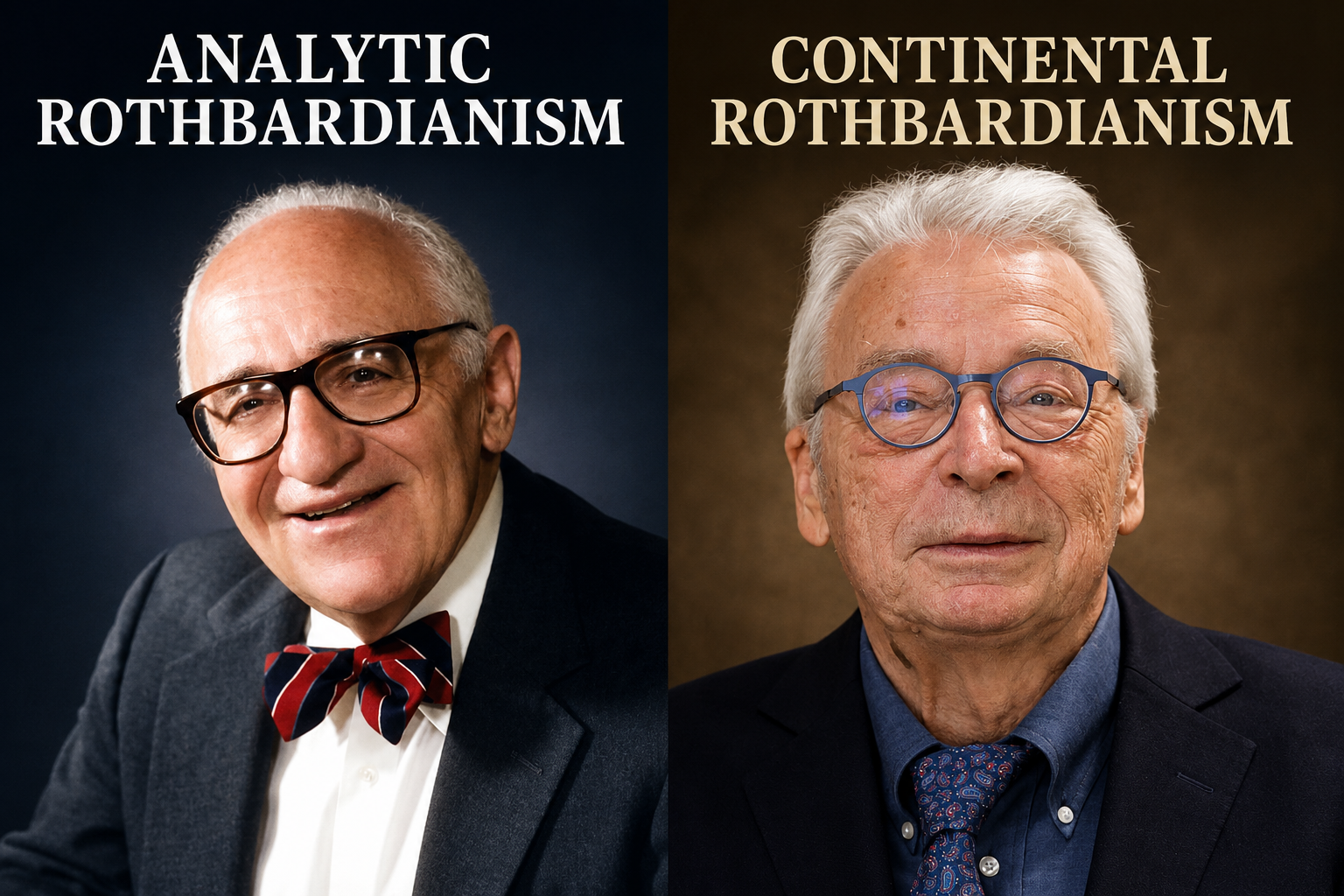
For most of its history, the Austrian School remained fundamentally analytic in style. Even when its thinkers entered philosophy, ethics, sociology, or political theory, they generally approached these subjects through conceptual clarity, methodological individualism, rational deduction, and systematic analysis. Ludwig von Mises and Murray Rothbard are perhaps the clearest examples of this tendency.
Their works were philosophical, yes, but philosophical in an analytic sense: precise definitions, logical structures, causal explanations, and a deep suspicion toward dialectics, historicism, and vague continental abstractions.
Something changed with Hans-Hermann Hoppe.
Because of Hoppe’s more openly philosophical and civilizational approach to the Austrian School, combined with his intellectual formation under Jürgen Habermas and the broader postwar German intellectual environment shaped by the Frankfurt School, one could argue that Hoppe unintentionally opened the door to what might be called Continental Rothbardianism within the Austrian tradition.
This was likely never Hoppe’s intention. Hoppe remained a strict defender of praxeology, methodological individualism, and Austrian economics. Yet his style, categories, and broader cultural analysis introduced something different into the Austrian School itself. He transformed Austrian analysis from a mainly economic and methodological framework into something closer to a broader critique of modern civilization.
Ironically, Hoppe imported into the Austrian School some of the same philosophical structures and intellectual instincts developed within postwar continental philosophy and critical theory.
To understand why this matters, we first need to understand the distinction between analytic Marxism and continental Marxism.
Analytic Marxism vs Continental Marxism
Continental Marxism traditionally refers to philosophical traditions associated with thinkers such as Theodor Adorno, Herbert Marcuse, and Antonio Gramsci. These thinkers were generally less concerned with strict economic analysis and more concerned with culture, ideology, alienation, psychology, social domination, civilization, and historical consciousness.
Rather than merely analyzing economic relations, continental Marxists attempted to build a broader philosophical interpretation of modern society itself. Marxism ceased being simply an economic doctrine and became a civilizational critique.
Analytic Marxism emerged partly as a reaction against this tendency. Thinkers such as G. A. Cohen, Jon Elster, and John Roemer attempted to reconstruct Marxist theory using conceptual clarity, formal reasoning, analytical philosophy, and methodological rigor. They rejected much of the obscurantism and dialectical vagueness associated with continental traditions.
In simplified form:
| Analytic Marxism | Continental Marxism |
|---|---|
| Logical and systematic | Dialectical and interpretive |
| Focus on clarity | Focus on critique |
| Economic structures | Culture and ideology |
| Analytic philosophy | Continental philosophy |
| Methodological rigor | Civilizational analysis |
Something remarkably similar happened inside the Austrian School.
The Austrian School as an Analytic Tradition
Despite frequent misunderstandings, the Austrian School was never merely “economics” in the narrow technocratic sense. It always possessed philosophical foundations. Mises explicitly grounded praxeology in epistemology and human action. Rothbard extended Austrian analysis into ethics, political philosophy, history, sociology, and legal theory.
Yet the Austrian School remained fundamentally analytic in orientation.
Its method relied on deduction from axiomatic principles. It emphasized causal explanation, methodological individualism, conceptual precision, and rational coherence. Austrian economics rejected historicism, positivism, and dialectical materialism precisely because these approaches dissolved clear causal analysis into historical abstraction or collective metaphysics.
This is why the Austrian School functions as both an economic school and a philosophical school.
Economically, it studies human action, exchange, prices, entrepreneurship, and market processes.
Philosophically, it studies the logical implications of action itself.
Praxeology is not cultural criticism in the Frankfurt sense. It is an analytic framework attempting to derive universal truths about action from the structure of human behavior itself.
Mises approached the world analytically.
Rothbard approached the Austrian School analytically.
Even when Rothbard became polemical or historical, his method remained rooted in causal explanation and systematic deduction. His critiques of interventionism, central banking, socialism, and state power were still fundamentally grounded in Austrian economic theory.
Another important element reinforcing the analytic character of the Austrian School is its long intellectual conflict with Marxism itself.
From Eugen Böhm von Bawerk to Mises and Friedrich Hayek, Austrian economists consistently approached Marxism through systematic logical criticism rather than dialectical speculation. Böhm-Bawerk’s critique of Marx’s labor theory of value, Mises’s critique of socialist calculation, and Hayek’s analysis of central planning all reflected the Austrian commitment to causal explanation, conceptual precision, and rational deduction.
This conflict also helps clarify the distinction between analytic and continental traditions.
As Austrian economist Peter Boettke notes, continental Marxism remained deeply influenced by Hegelianism, dialectics, and broad historical critique, while analytical Marxism consciously attempted to abandon these methods in favor of analytical philosophy, logical rigor, and conceptual clarity.
In many ways, the Austrian School historically positioned itself closer to the analytic side of this divide. Austrians rejected dialectical materialism, historicism, and equilibrium abstractions not because they opposed philosophy, but because they believed social theory had to remain grounded in methodological individualism and logically deduced human action.
Even Austrian critiques of socialism were fundamentally analytic rather than civilizational. Mises criticized socialism primarily because economic calculation becomes impossible without market prices. Hayek criticized central planning because dispersed knowledge cannot be centralized rationally. Rothbard criticized interventionism because it distorts market coordination and property relations.
The emphasis remained economic, methodological, and causal.
Hoppe and the Continental Turn Within Austrian Economics
Hoppe altered the tone of the Austrian School.
Under the influence of Habermas and the broader German philosophical tradition, Hoppe increasingly extended Austrian categories into a broader critique of democracy, egalitarianism, modernity, mass society, and cultural decline.
This is where Continental Rothbardianism begins.
Hoppe does not merely analyze state intervention economically. He analyzes civilization itself.
He does not merely critique inflation or economic planning. He critiques egalitarian culture, democratic psychology, intellectual classes, and modern social decay.
Like many continental theorists, Hoppe constructs something resembling a broad civilizational critique, except inverted politically.
Where the Frankfurt School saw domination in capitalism, Hoppe sees domination in democracy and egalitarianism.
Where Marcuse critiques bourgeois conformity, Hoppe critiques mass democratic leveling.
Where Gramsci analyzes cultural hegemony, Hoppe analyzes state intellectuals and democratic ideology.
In both cases, the analysis moves beyond economics into civilization-wide critique.
This broader mode of analysis begins to resemble the total critiques developed within continental philosophy itself.
This is why one could argue that Hoppe unintentionally introduced a continental tendency into Austrian economics itself.
His followers increasingly speak less like economists and more like civilizational theorists, anti-modern philosophers, cultural critics, or reactionary sociologists. Economics remains present, but it no longer occupies the central role it held under Mises or Rothbard.
The Austrian tradition partially shifts from praxeological analysis toward civilizational diagnosis.
Argumentation Ethics and the Return of Relativism
One could also argue that Hoppe’s argumentation ethics contains its own subtle form of relativism, despite presenting itself as a universal and rational foundation for ethics.
At first glance, argumentation ethics appears radically anti-relativist. Hoppe attempts to derive universal libertarian norms from the necessary presuppositions of argumentation itself. Anyone engaging in discourse must implicitly recognize self-ownership, control over one’s body, and norms of peaceful interaction. From this, Hoppe concludes that libertarian property ethics are objectively justified.
However, critics could argue that this entire framework remains dependent on participation in a very specific human practice: argumentation.
In other words, the validity of Hoppe’s ethics only emerges inside the context of rational discourse between actors who already accept the value of propositional exchange. The moment someone rejects argumentation itself as the ultimate grounding mechanism for ethics, the universality of the system becomes less absolute than Hoppe suggests.
This creates a subtle but important shift. Rather than grounding ethics in an objective metaphysical order, natural law, divine command, or universal moral realism independent of human interaction, Hoppe grounds ethics in the procedural norms implicit within discourse itself. Ethics becomes tied to the conditions of communication.
Critics may therefore argue that argumentation ethics transforms morality into a discourse-dependent framework rather than a universally binding ontological truth.
Ironically, this resembles certain tendencies found within continental philosophy and even the Frankfurt School itself, particularly through the influence of Habermas’s discourse ethics. Habermas similarly attempted to ground legitimacy in the procedural conditions necessary for rational communication. Truth and legitimacy emerge not from metaphysical absolutes, but from the structures implicit in communicative action.
Hoppe radically changes the conclusions, arriving at private property and libertarian ethics rather than democratic egalitarianism, but the structure remains surprisingly similar. In both systems, legitimacy emerges through discourse itself rather than from external metaphysical foundations.
One could therefore argue that argumentation ethics introduces a form of procedural relativism.
The norms are “universal” only insofar as one accepts the framework of rational argumentation as authoritative. But why must argumentation itself be the ultimate foundation of ethics? A nihilist, irrationalist, existentialist, traditionalist, religious authoritarian, or pure egoist could simply reject the premise entirely. Hoppe can demonstrate that such individuals enter a performative contradiction when they argue against argumentation ethics while simultaneously engaging in argumentation, but critics may respond that this only applies during the act of discourse itself, not necessarily to life as a whole.
In this interpretation, argumentation ethics does not fully escape relativism. It merely relocates the foundation of morality from subjective preference to communicative procedure.
This is why some critics argue that Hoppe, despite his rationalism, still inherits part of the continental and post-Marxist turn toward discourse-centered philosophy. His ethics no longer rests on classical natural law in the Aristotelian or Thomistic sense. Instead, legitimacy becomes inseparable from the structures of communication and intersubjective justification.
Thus, even while Hoppe rejects postmodern relativism politically and culturally, one could argue that argumentation ethics preserves a sophisticated procedural relativism at the philosophical level.
The Difference Between Analytic Rothbardianism and Continental Rothbardianism
Analytic Rothbardianism remains primarily concerned with:
- Praxeology
- Economic calculation
- Property theory
- Methodological individualism
- Market processes
- Institutional analysis
- Rational deduction
Continental Rothbardianism expands into:
- Cultural decay
- Mass psychology
- Civilizational decline
- Elites and intellectual classes
- Traditionalism
- Social cohesion
- Cultural homogeneity
- Critiques of modernity itself
This does not necessarily make Continental Rothbardianism wrong. It simply represents a transformation in emphasis and intellectual style.
One tendency remains primarily analytic.
The other becomes increasingly continental.
Rothbard Himself Remained Analytic
Rothbard certainly possessed broad philosophical interests. He wrote on ethics, history, sociology, revisionist historiography, and political theory. But his method remained fundamentally analytic in the Rothbardian sense.
Even when discussing culture or ideology, Rothbard generally reduced problems back to institutions, incentives, property relations, interventionism, and economic causality.
He never fully transformed the Austrian School into a civilizational metaphysics.
Rothbard radicalized Austrian economics politically, but he did not continentalize it philosophically.
Hoppe did.
And through that shift, intentionally or not, a new intellectual tendency emerged inside Austrian economics itself:
Continental Rothbardianism.
An Austrian tendency less concerned with pure economic analysis and more concerned with civilization itself.
Leave a Reply