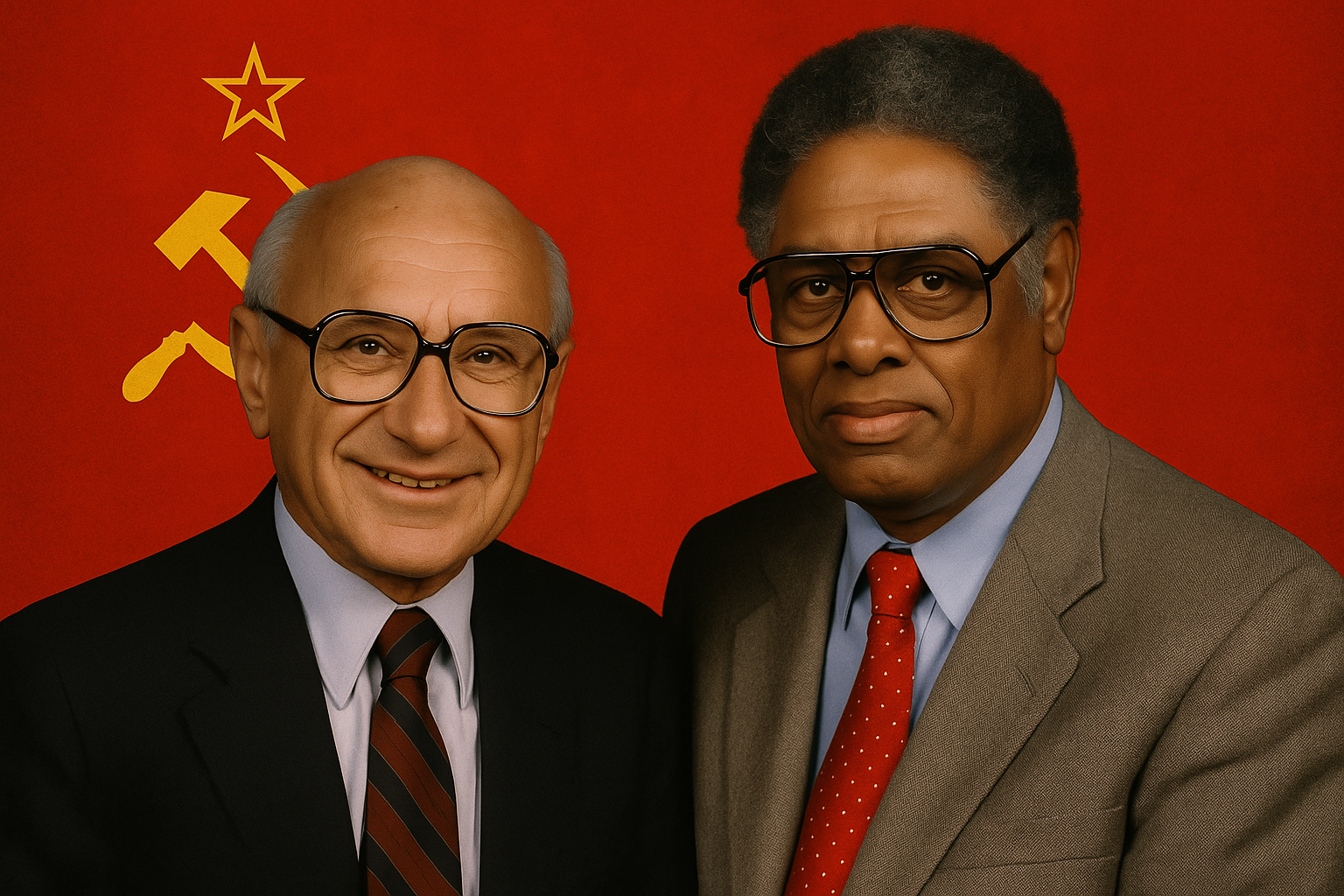
There’s a certain irony in how the modern “libertarian mainstream” has been built on men who, in truth, were defenders of the State. Milton Friedman and Thomas Sowell chief among them. They are treated as prophets of capitalism, yet their core doctrines amount to sanitized, technocratic socialism.
1. The Worship of the State’s Machinery
Friedman’s entire philosophy rests on preserving the State’s monopoly on money and law, merely “improving” it with better management. He didn’t oppose central banking, he wanted a more efficient central bank. He didn’t reject taxation, he sought a negative income tax. He didn’t call for abolition, he called for “optimization.” In other words, Friedman was the perfect bureaucrat, a communist with a calculator.
2. Market Socialism in Disguise
Like the Marxists, Friedman believed the State should “regulate the regulators” through policy rather than principle. He accepted the premise that coercion can be moral if done rationally. His “school choice vouchers” are merely the Soviet rationing system repackaged for suburban America. The State still decides who gets what, it just allows competition within its cage.
Thomas Sowell, his intellectual heir, dressed these ideas in sociological prose. But his worldview remained fundamentally collectivist. The “constrained vision” of human nature still treats individuals as statistical aggregates to be managed, not sovereign beings to be left alone. Sowell’s economics serves to justify the State’s existence, not to question it.
3. The Myth of Pragmatism
Both men loved to call themselves “pragmatists.” But pragmatism is the philosophy of cowards, those who refuse to follow logic to its moral conclusion. Rothbard and Konkin called this out decades ago. Pragmatists are always the middle managers of tyranny. They accept the premise of central planning, then beg for efficiency.
A truly radical mind understands that you cannot fix a parasite, you must remove it. Friedman and Sowell never dared imagine a world without the parasite, only one where it bites less often.
4. Capitalism Without Capitalists
Real capitalism requires private property and voluntary exchange, not central banks, fiat currency, and coerced redistribution under the guise of “monetary policy.” Friedman’s Chicago School, by contrast, gave intellectual cover to the corporate state complex, the same system Mussolini called corporatism. Their capitalism is just communism with better branding.
Sowell’s endless defense of “Western civilization” misses that the West was not built by bureaucrats and professors, but by free individuals defying authority. His version of the “constrained vision” constrains freedom itself, a preemptive surrender to statism masked as realism.
5. Capitalism as a Hollow Term
“Capitalism” today is a hollow term. It no longer describes a social order rooted in private property, entrepreneurship, and voluntary exchange. It describes the managed economy of central banks, corporate cartels, and political privilege. What once meant the free interplay of individual actors now means the coordination of technocrats and bureaucrats under the illusion of “market efficiency.”
Real capitalism presupposes ownership without permission, the right to produce, trade, and accumulate wealth outside the reach of the state. But in the modern world, capital itself is state-issued. Money is no longer a store of value born from production, but a political instrument of social engineering. The “capital” in capitalism has been nationalized in everything but name, with private firms dependent on central bank liquidity, subsidies, and legal monopolies.
Friedman and the Corporate State
Milton Friedman’s “free market” rhetoric gave moral legitimacy to this hybrid system. By accepting fiat currency, central banking, and compulsory taxation as necessary tools of economic management, the Chicago School helped transform capitalism from a moral principle into a policy instrument. Their “freedom” was always conditional, granted by the state, priced in state currency, and limited by “acceptable” political parameters.
In practice, this created corporatism, a merger of corporate and state power. Mussolini named it openly; Friedman and his successors simply disguised it with mathematical models. Their capitalism differs from socialism only in method, not in spirit. Both centralize control, both rely on coercion, and both suppress the spontaneous order of genuine markets.
The Sowell Paradox
Thomas Sowell’s defense of “Western civilization” suffers a similar flaw. His “constrained vision” of human nature justifies the very constraints imposed by bureaucrats and planners. He venerates the achievements of the West while ignoring that those achievements were born not from obedience, but from rebellion, rebellion against kings, priests, and states.
The true West was built by free individuals, not managerial elites. It was the entrepreneur, the craftsman, and the philosopher who advanced civilization, not the professor or policy maker. Sowell’s realism reduces liberty to an accounting problem, treating freedom as something to be “balanced” rather than lived. In doing so, he turns a vision of liberty into a doctrine of resignation.
6. Why Friedman and Sowell Are Communists — In Summary
- They accepted the premise of central planning.
Instead of abolishing coercion, they sought to manage it “efficiently,” endorsing central banks, taxation, and policy control — the tools of socialism dressed in free-market language. - They redefined capitalism as policy, not principle.
Their “market economics” depends on state permission and regulation, turning voluntary exchange into a bureaucratic experiment rather than a moral ideal. - They legitimized the corporate-state alliance.
By defending fiat money, legal monopolies, and state-protected corporations, they gave intellectual cover to modern corporatism — socialism for the rich. - They reduced freedom to a statistical variable.
Sowell’s “constrained vision” and Friedman’s monetarism treat individuals as data points, ignoring human action, ethics, and self-ownership — the essence of genuine liberty. - They replaced rebellion with obedience.
Their realism glorified compliance and “policy improvement,” not the entrepreneurial defiance that built civilization. They preached reform where abolition was required. - They preserved the State as the master of all exchanges.
Their entire worldview rests on accepting the State as permanent and legitimate — a position no true capitalist or libertarian can hold.
In short: Friedman and Sowell defended the managed economy of the State, not the spontaneous order of the market. They spoke the language of capitalism while upholding its opposite — the soft, technocratic communism of modern America.
Leave a Reply