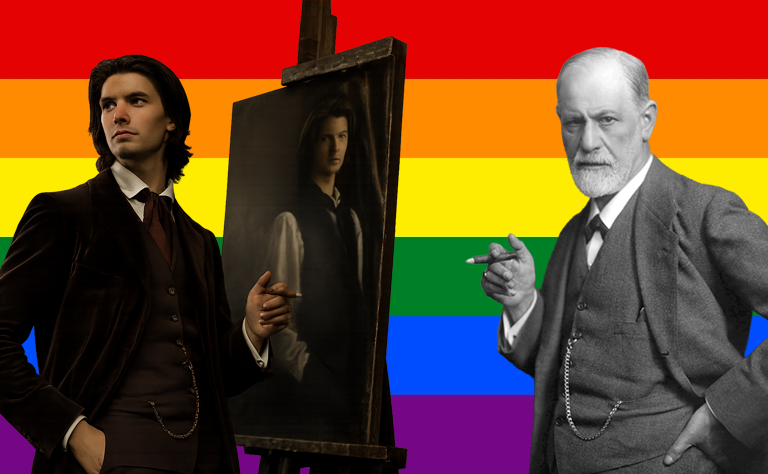
The Picture of Dorian Gray is not merely a novel about decadence or Victorian morality. It operates as a near-perfect structural model for understanding what happens when narcissism becomes the organizing principle of human relations.
Dorian does not behave as a conventional libertine. He acts as an agent whose ultimate end is the maximization of his subjective image. Other individuals, whether men or women, are never partners in any meaningful sense. They are temporary means in a process of narcissistic intensification.
At this point, sexual difference ceases to be structurally decisive. It is not abolished, but absorbed into a higher logic. Selection is no longer oriented toward the opposite sex or reproduction. It is oriented toward the capacity of an individual to sustain and amplify the narcissistic experience.
The Portrait as a Hyperreal Device
The portrait is the central mechanism of the novel. It introduces a radical separation between appearance and reality, between the sign and the cost.
Jean Baudrillard would describe this as the substitution of the real by the sign. Dorian’s physical body remains intact, socially legible, and aesthetically perfect, while the portrait absorbs the real consequences of his actions.
This dissociation produces a decisive effect: the removal of constraint.
Under ordinary conditions, human action is limited by visible consequences. Here, those consequences are displaced outside the social field. Dorian can therefore multiply experiences, intensify relations, and destroy others without any corresponding degradation of his visible self.
The result is a fully mediated existence. He no longer lives in reality, but within a moral simulation where indicators replace lived experience.
Narcissistic Exploitation Without Sexual Constraint
Dorian’s relationships confirm this structure.
Basil Hallward represents total affective investment, bordering on the religious. His attachment is asymmetrical, directed toward an object incapable of reciprocity. Allan Campbell exemplifies purely instrumental relations, maintained through coercion and blackmail. The ruined young men and abandoned women are the externalities of this system.
The crucial point is that these relations are not determined by Dorian’s sexual orientation. They are determined by his narcissistic structure.
His apparent bisexuality is not openness. It is an expansion of the field of exploitation. Where an ordinary individual is limited by relatively stable preferences, Dorian continuously extends his domain of action. Any individual becomes usable, provided they contribute to the intensity of the experience.
Hypergamy Without Reproduction
In a traditional framework, hypergamy is tied to selection, status, and reproduction. It presupposes duration, hierarchy, and biological constraint.
In Dorian’s case, these elements disappear.
Selection becomes instantaneous. The criterion is no longer the enduring quality of a partner, but their immediate capacity to generate narcissistic intensity. Relations are not cumulative. They are serial.
He does not seek the best partner. He seeks the most intense experience available at any given moment.
This produces a form of hypergamy detached from reproduction. A purely aesthetic and psychological hypergamy in which individuals are consumed and replaced without continuity.
Oscar Wilde and the Formalization of a Type
Oscar Wilde is often interpreted as projecting himself into Dorian. This reading is partially correct, but insufficient.
Wilde operated within a society where certain forms of desire were legally and socially prohibited. This produced a stylization of behavior, an aestheticization of relations, where desire is mediated through appearance, language, and performance.
Dorian is not simply autobiographical. He is the formalization of this logic taken to its extreme. He represents an individual for whom aesthetics fully substitutes reality, and for whom human relations are entirely mediated through that substitution.
Anticipation of Contemporary Findings
Contemporary psychological research, including work disseminated through ScienceDirect and PubMed, supports key elements of this structure.
These studies identify correlations between narcissism and opportunistic sexual behavior, increased behavioral flexibility, and a tendency to instrumentalize relationships for validation and stimulation.
What the novel presents in literary form appears today as an identifiable psychological profile: an individual whose identity depends on constant external validation, and whose relationships are organized around that dependence.
Conclusion
Dorian Gray is not merely an immoral character. He is a model.
He demonstrates what happens when the real costs of action are displaced outside the visible field, when the image replaces the body, and when other individuals are reduced to variables in a system of self-intensification.
Under these conditions, sexual difference does not disappear. It loses its structuring function. It becomes a parameter within a more fundamental logic.
A logic in which the relation is no longer a relation, but a process of extraction.
Leave a Reply