
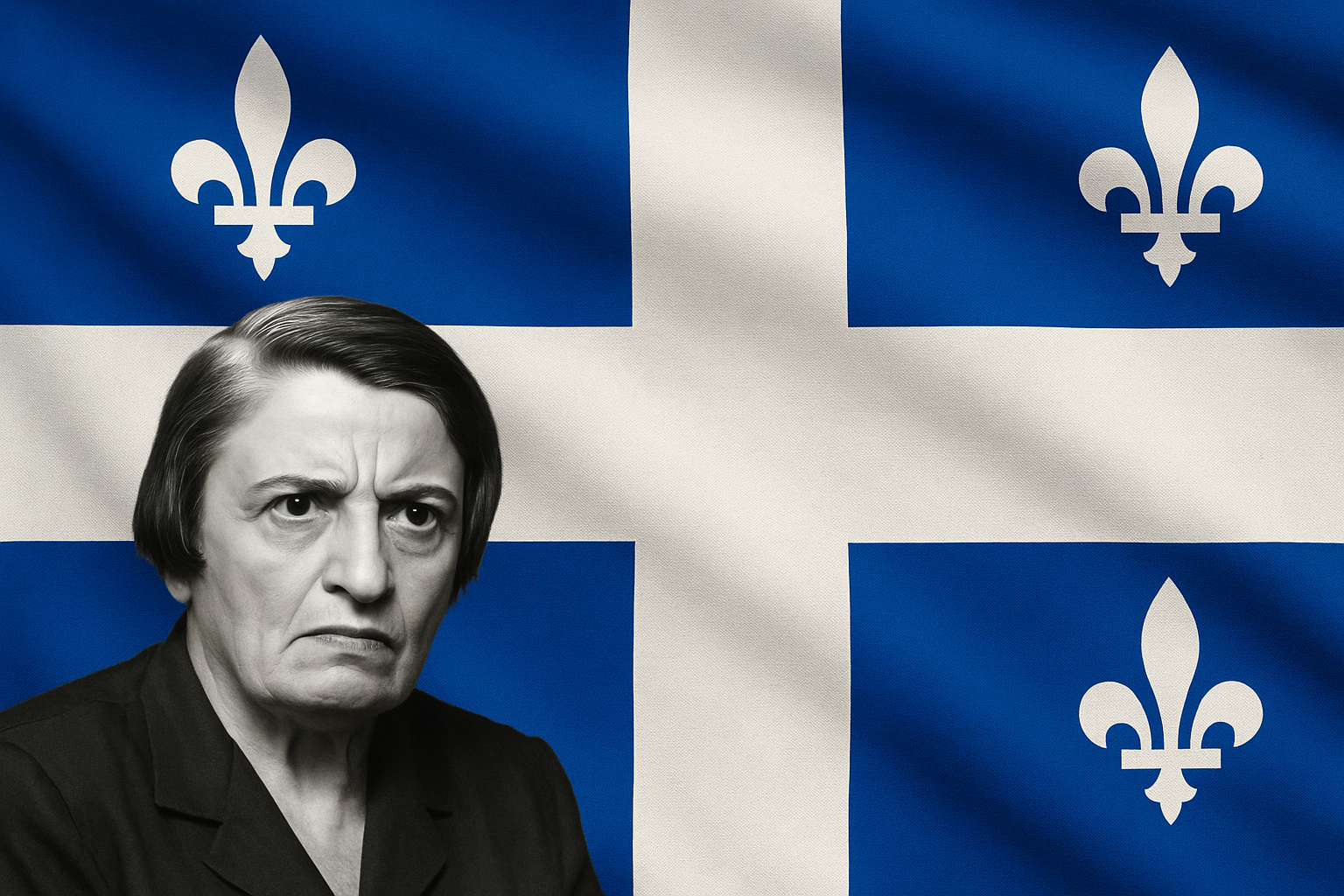
Ayn Rand famously argued that racism is the most primitive and crudest form of collectivism. In her view, judging someone by their ethnic or cultural origin instead of their individual character is a regression to tribal thinking where the person disappears behind the group. From a moral individualist standpoint, the critique is valid. But the political reality of modern Québec reveals something more complex. Group identity does not always function as an oppressive tribal force. Sometimes it acts as resistance to a much larger collectivism that tries to absorb everyone into a single narrative.
To be clear, I do not agree with the Québec state’s cultural agenda or its nationalist project. That is another discussion entirely. I simply use Québec as a concrete example to illustrate a philosophical pattern: collectivisms often create their own counter collectivisms, which fracture into smaller and smaller units until only the individual remains.
Québec as a Case Study of Conflicting Collectivisms
Québec is officially a francophone society, but it is ethnically and culturally layered. A francophone majority coexists with anglophones and large immigrant communities. The provincial state promotes a civic Québec identity where all residents are expected to adopt the cultural norms of the French speaking majority. This is one form of collectivism: a unifying political identity presented as neutral and civic.
On the other hand, the Canadian federal state promotes multiculturalism. In this system, people are encouraged to maintain their original cultures while integrating into a Canadian framework. This is another form of collectivism: unity through diversity, where each group is a cell in a national mosaic. In both systems, individuals are encouraged to see themselves through the lens of a larger collective identity, whether Québecer or Canadian.
Neither system is tyrannical, but both shape identity from above. And although I describe these dynamics, I am not endorsing either project. I only highlight them to show how collectivist narratives attempt to standardize human identity.
Separatism, Language Tensions, and the Problem of Forced Unity
Now imagine these political tensions intensifying. Francophone separatists argue that their culture is threatened by immigration, anglophone enclaves, and federal bilingualism. Immigrants argue that assimilationist pressure erases their traditions. Anglophones argue that nationalist laws marginalize them. Instead of merging into one Québec identity, society begins to fragment.
Francophones emphasize cultural preservation
Immigrants emphasize their collective autonomy
Anglophones emphasize minority rights
Each group pushes back against being dissolved into a single civic collective. They resist uniformity.
Here is the paradox. Rand said racism and ethnic thinking are primitive collectivisms. But in this case, ethnic consciousness actually disrupts a larger, more abstract collectivism: the state’s attempt to create one unified identity for all.
Propaganda and the Dream of Homogeneity
The Québec state uses education, cultural funding, public media, and language laws to reinforce the idea of a shared identity. The Canadian state uses multicultural policy, bilingualism, and national symbolism to promote a different unified identity. These are soft forms of propaganda, not in the sinister sense, but in the sociological sense: systems that shape how people understand themselves.
Both projects insist that the individual should melt into a political narrative. Québec’s version insists on cultural convergence. Canada’s version insists on multicultural equilibrium. The language differs, but the underlying logic is the same. The state defines who you are supposed to be.
But real life does not operate that cleanly.
Residual Friction: When Group Differences Resist Fusion
Even when it manifests in unhealthy ways, ethnic or linguistic tension disrupts attempts at total fusion. A francophone who fears losing cultural heritage, an anglophone resisting nationalist pressure, or an immigrant community preserving its traditions all act as barriers to the state’s homogenizing aspirations. Their identities resist being shaped into a single mass.
This does not morally justify racism or hostility. It simply reveals that difference, even messy difference, prevents the formation of a perfectly unified collective identity. The stronger the state pushes toward a single identity, the more sub groups insist on their distinctiveness.
The state pushes for fusion
Communities resist and fragment
Fragmentation prevents total collectivism
This mirrors the initial philosophical argument you referenced earlier about communes splitting into smaller communes until only individuals remain.
Fragmentation As a Natural Counterweight to Collectivism
Québec becomes a living example of two collectivisms colliding.
First, there is nationalist collectivism that wants unity under a shared Québec culture.
Second, there is multicultural collectivism that wants unity under a shared Canadian mosaic.
But below these two systems are real people who continue to split into smaller and smaller identity clusters. Within francophones there are regional, ideological, and class divisions. Within immigrants there are dozens of national groups. Within anglophones there are cultural and political factions. These groups split further into local communities, then families, then individual persons.
At each step, collectivism weakens. The group shrinks until it no longer contains anything smaller. Eventually the chain reaches its final unit: the individual.
Conclusion
Neither Québec Collectivism Nor Ethnic Tribalism
Only the Individual
Rand was right to warn against reducing individuals to their group identity. But Québec shows that another threat also exists. Large scale political projects that try to absorb everyone into a unified identity can be just as dangerous to individual freedom. Even though I do not support the Québec state’s cultural agenda, its nationalist ambitions illustrate the phenomenon perfectly. Fragmentation, even when chaotic or unpleasant, prevents the complete absorption of individuals into a collective narrative.
Ethnic or linguistic tensions in Québec do not justify racism. They simply demonstrate that attempts to erase all differences inevitably produce friction. This friction prevents the state from creating a single homogeneous identity and keeps political collectivism in check.
The goal is not to choose between tribalism and state imposed unity. The goal is to defend a third position: the individual as an irreducible reality, beyond race, beyond group narratives, and beyond government projects.
Neither ethnic group identity nor Québec’s identity project nor Canada’s multicultural project should define anyone. Only the individual should.
Leave a Reply