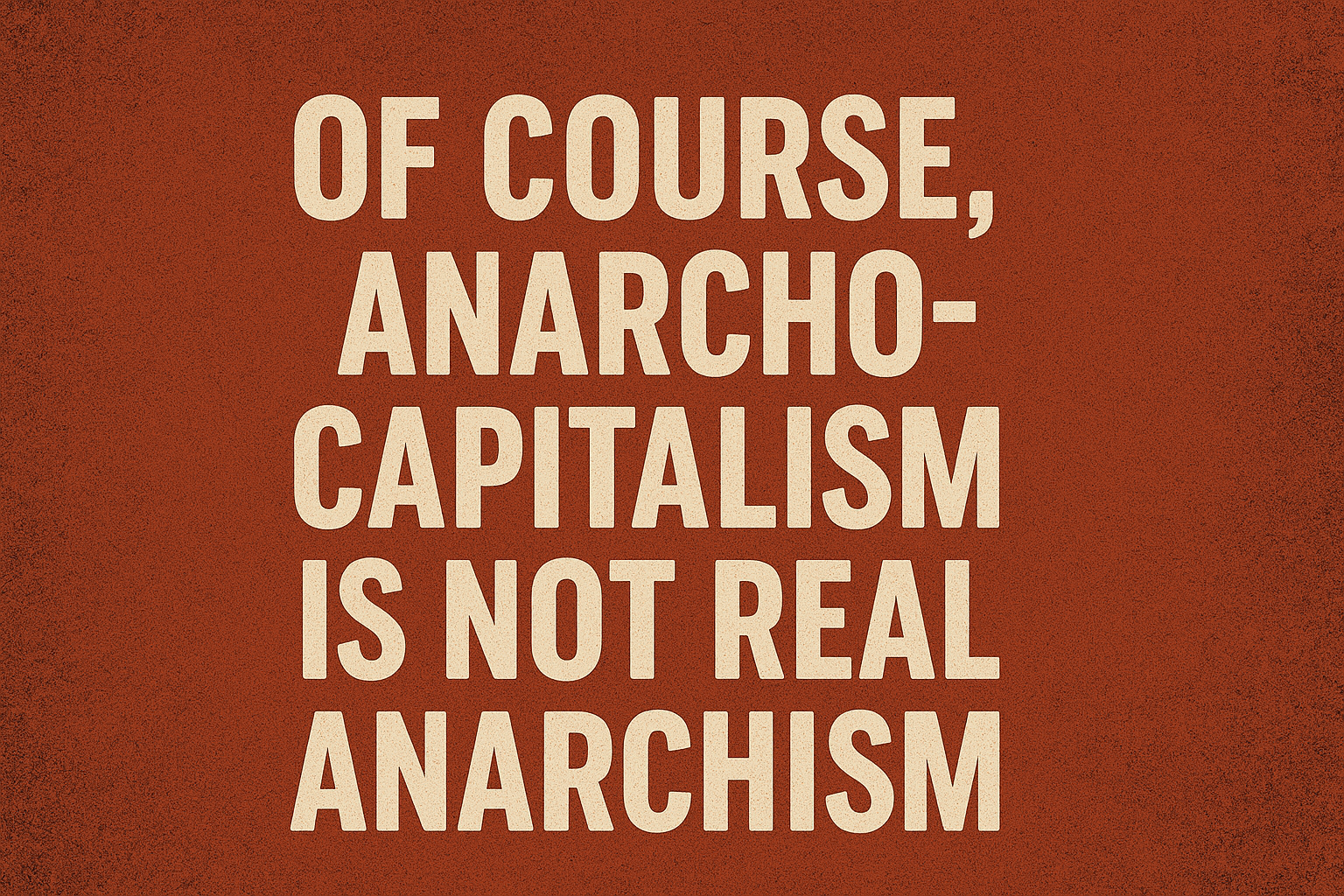
I’ve long believed that words matter — especially the word anarchism. It once meant the total absence of domination, of rulers and masters in every form. It meant a radical commitment to voluntary cooperation, to the sovereignty of the individual mind, and to the dignity of all free exchange untainted by coercion. But today, the word has been hijacked. When I hear self-styled “anarcho-capitalists” claim the mantle of anarchism while defending systems of hierarchy, wage dependency, and rent extraction, I see not liberation, but the same pyramid of power — merely repainted in gold and labeled “freedom.”
True anarchism, as the individualist and agorist tradition has always understood it, begins with self-ownership and extends only as far as voluntary consent allows. It does not sanctify the right to rule by wealth any more than the right to rule by law. To the genuine anarchist, capitalism — as it exists — is not a free market but a state project: a web of privilege, monopoly, and protectionism sustained by legislation, policing, and intellectual property. Anarcho-capitalism mistakes the master’s house for the marketplace of equals.
Agorism, as envisioned by Samuel Edward Konkin III, seeks to build that true marketplace — the agora — from the ground up. It rejects both the authoritarianism of the state and the exploitation inherent in capitalist hierarchy. It invites individuals to exchange, create, and cooperate outside the sanctioned economy: in the black and grey markets where liberty lives when legality fails. The counter-economy is not about getting rich under capitalism; it is about rendering capitalism obsolete through voluntary, peer-to-peer trade.
Like Tucker, Spooner, and Stirner before him, the agorist does not dream of governing others, nor of being governed. He recognizes that freedom cannot coexist with institutional domination — whether enforced by the State’s gun or by the employer’s contract written under conditions of economic dependency. To the individualist, “property rights” beyond personal use are not liberty but legal fiction: they require the very police, courts, and hierarchies that anarchists reject.
Anarcho-capitalism, in contrast, clings to those fictions and calls them sacred. It worships ownership rather than use, privilege rather than autonomy, accumulation rather than cooperation. It tells the worker he is free because he signed the contract — as if necessity were consent and survival were choice. It preserves the structure of command while discarding the flag that once justified it.
What I defend, then, is not “capitalism without the state,” but markets without masters. Voluntary exchange without coercion, entrepreneurship without exploitation, community without compulsion. The true anarchist does not abolish trade; he humanizes it. He does not destroy wealth; he removes its monopoly. In the agora, we meet as equals — not as employers and employees, landlords and tenants, but as self-owning individuals freely cooperating to live, create, and thrive.
That is anarchism. The rest is branding.
Leave a Reply