
Reusing the Same Analytical Structure With New Names and a More Local Example
In the initial text, the argument explored how collectivist identities, even irrational ones like racial tribalism, may sometimes function as forces of fragmentation rather than fusion. The original framework examined a commune splitting into two, then each of those communes breaking into factions, and eventually dissolving into individuals. Here, I acknowledge the existence of that first text and reuse its logical scaffolding, but I apply it to a much smaller and more intimate setting with new names, new groups, and a more local dynamic.
1. The Village of Bristal, A Small Community With Two Ethnic Groups
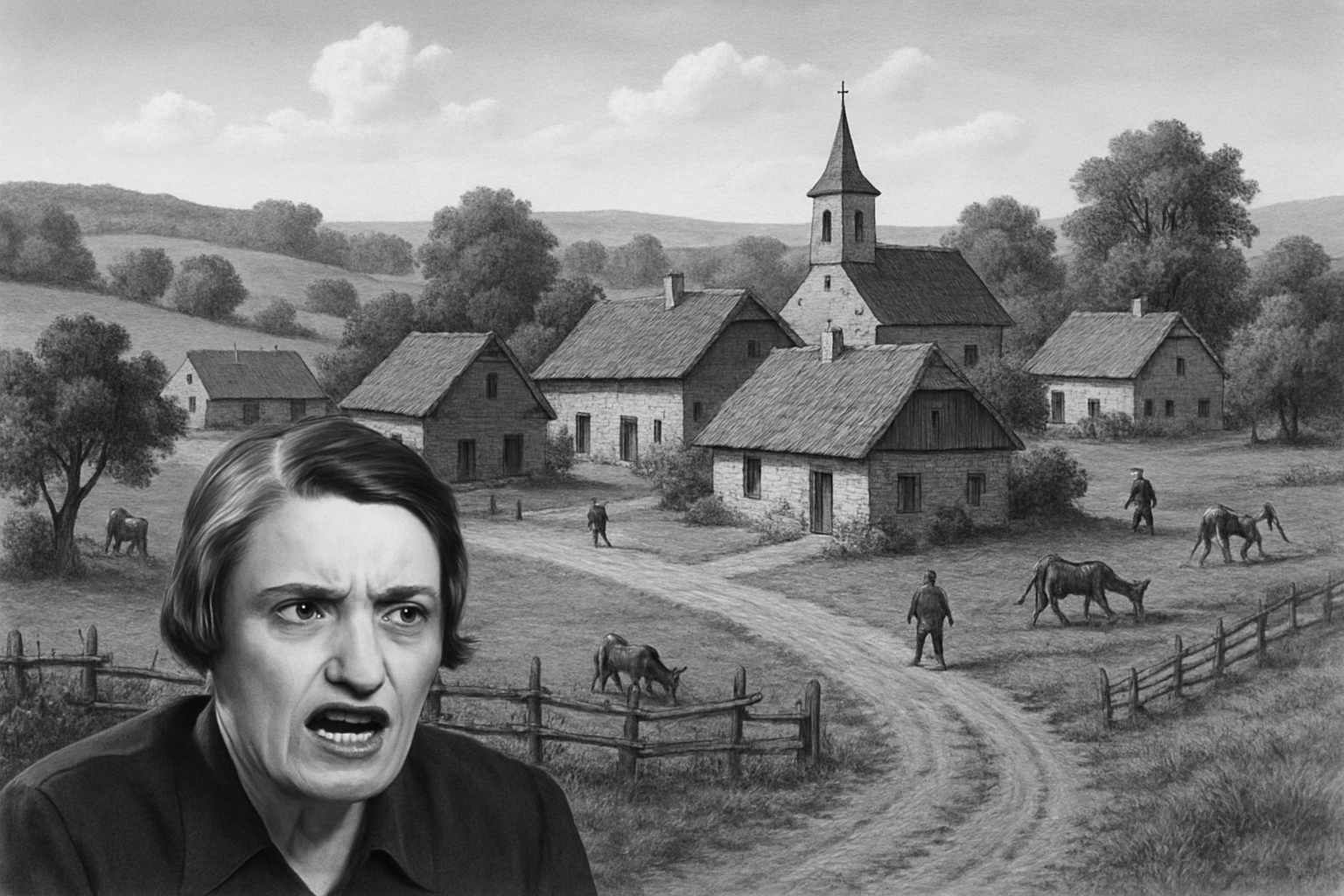
Instead of a large commune, imagine a tiny village named Bristal. Only a few hundred people live there.
Two ethnic communities share this limited territory:
- the Lunari, semi nomadic shepherds
- the Demerans, settled agriculturalists
Despite their differences, the village council promotes a unifying identity:
“We, the People of Bristal.”
This identity acts as a small scale collectivism held together by shared taxes, shared rituals, a local militia, and village traditions.
2. The Split, Bristal Fractures Into Two Micro Communes
Over time, disagreements arise. The Lunari feel marginalized, the Demerans feel culturally threatened. Eventually, the village dissolves and what was once Bristal becomes two separate hamlets:
- Lunaris, inhabited by the Lunari
- Demerhold, inhabited by the Demerans
Both new communes embrace a stronger ethnic identity. What seems like unity quickly hardens into separation. This repeats the logic of the initial text but on a smaller scale.
3. Micro Fragmentation Inside Lunaris and Demerhold
Unity does not last long in either hamlet.
Inside Lunaris, the Lunari divide into four groups:
- Hill Lunari, mountain shepherds
- Forest Lunari, semi hermits living near the woods
- Young Wanderers, youth who want modern reforms
- Old Blood Lunari, strict traditionalists
Inside Demerhold, the same pattern appears:
- Grainwardens, grain farmers
- Riverhands, fishermen and boatmen
- Craft Demerans, artisans and metalworkers
- Faithkeepers, religious conservatives
Even in a tiny village turned tiny hamlets, collectivist unity cracks almost immediately.
4. Further Fragmentation, Clans, Lineages, and Households
The four factions in Lunaris begin to split again.
- Hill Lunari divide into high ridge and low ridge herders
- Forest Lunari divide over land management traditions
- Young Wanderers divide into moderates and radicals
- Old Blood Lunari divide along hereditary lines
The same occurs in Demerhold.
- Grainwardens divide by farming methods
- Riverhands divide by trading routes
- Craft Demerans divide by guild practices
- Faithkeepers divide by ritual interpretation
Factions shrink into sub factions, sub factions shrink into clans, clans shrink into lineages, and lineages eventually become households.
The collectivist structure becomes thinner and narrower at each step until it reaches its final limit.
5. Final Atomization, The Individual as the Last Unit
After enough division, what remains is the only unit that cannot be split further without ceasing to exist, the individual.
The chain of fragmentation looks like this:
- One village, Bristal
- Two ethnic hamlets, Lunaris and Demerhold
- Four factions inside each
- Smaller sub factions
- Lineages and households
- Individuals
This reproduces the conclusion of the initial text: even at the smallest scale, collectivism tends to fracture. The individual is the only unit that remains whole. This is the smallest and purest form of decentralized anarchism.
6. Meta Conclusion, The Argument Reapplied on a Smaller Canvas
By acknowledging the initial argument and applying it to a miniature version, we see the same pattern repeating on a lower resolution. A unified village splits along ethnic lines, which then split internally, which then split again, until nothing remains except the sovereign person.
The scale changes, but the logic remains identical.
Leave a Reply