
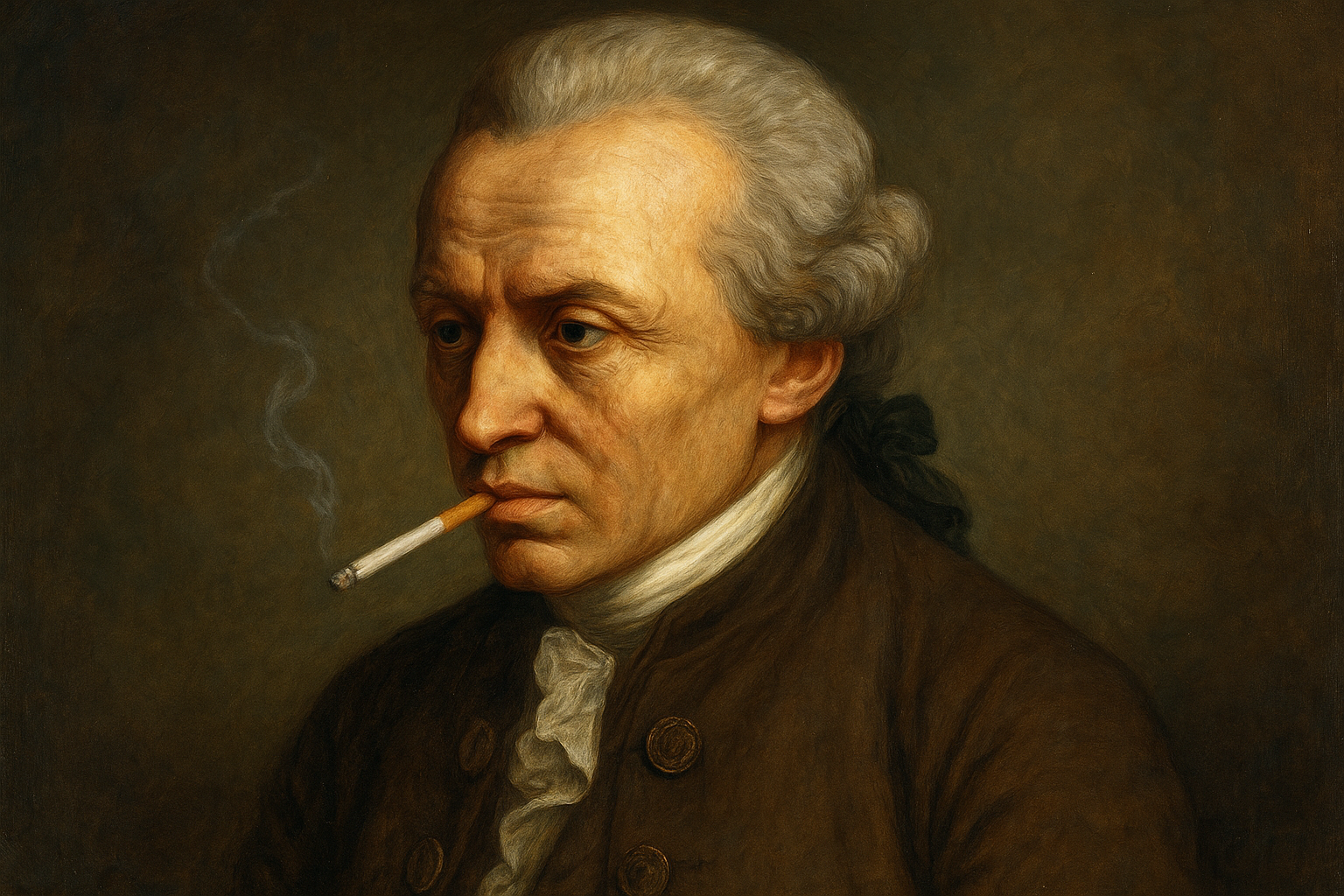
Kant’s concept of unsocial sociability (ungesellige Geselligkeit) is one of the most illuminating ideas for understanding the dynamics of human evolution. It describes a fundamental tension in human nature: we are driven to live with others, yet we are equally driven to distinguish ourselves, to compete, to assert our uniqueness.
This tension is not a flaw. It is the motor of human evolution—of culture, reason, and the higher forms of life.
What you call elitist individualism — the idea that the autonomous, self-elevating individual who separates himself from ideological herds is the true creative force — fits perfectly within this Kantian framework. Far from contradicting Kant, elitist individualism intensifies what Kant already saw in human nature.
This article explains why.
1. Unsocial Sociability: The Kantian Engine of Human Evolution
For Kant, human nature contains two opposing tendencies:
- Sociability: the need to live with others, be recognized, communicate.
- Unsociability: the desire to be independent, distinct, superior, irreplaceable.
The conflict between these tendencies generates:
- culture,
- the arts,
- social institutions,
- and the intellectual and moral evolution of humanity.
Without this tension, nothing would evolve.
2. Elitist Individualism: The Modern Form of This Creative Tension
Elitist individualism holds that the evolution of human forms comes from superior individuals — those who can detach themselves from collective determinisms.
It is:
- an ethic of verticality,
- a cultivation of singularity,
- a discipline of self-overcoming,
- a refusal of mediocrity,
- a commitment to self-legislation (auto-nomy).
This is the modern embodiment of the Kantian ideal of the individual who dares to think for himself (sapere aude).
3. Why the Two Frameworks Align Perfectly
A. The Elitist Individual Actualizes Productive Unsociability
Kant sees the singular, non-conforming individual as the one responsible for humanity’s evolution.
The elitist individual pushes this dynamic to its highest intensity.
B. The Elitist Individual Is Not Anti-Social — He Is Transformative
He uses society as a field of testing, comparison, and self-refinement — not as a refuge.
C. Both Converge in Autonomy
For Kant, freedom means self-legislation.
The elitist individual embodies precisely this.
4. New Addition: How Elitist Individualism and Unsocial Sociability Align with the Categorical Imperative
At first glance, elitist individualism — with its emphasis on singularity and verticality — might seem to contradict the categorical imperative, since Kant insists that every human being must always be treated as an end, never merely as a means.
But in reality, the opposite is true:
Elitist individualism is deeply compatible with the categorical imperative precisely because it recognizes every individual as an end in himself.
Here is why:
- The elitist individual does not seek to use others as instruments; he seeks to elevate himself through his own effort, not through exploitation or manipulation.
- He acknowledges the intrinsic dignity of every person — not because all are equal in capacity, but because each possesses rational autonomy.
- He demands of himself what he recognizes as possible in others: effort, responsibility, inner discipline.
- His unsociability is not contempt; it is a refusal to reduce others to tools for validation, comfort, or dependency.
Thus, elitist individualism does not turn society into a herd to dominate.
It sees society as a field of autonomous beings, each endowed with dignity and their own potential for self-legislation.
His elitism is moral, not tyrannical.
He rises without enslaving; he surpasses without dehumanizing; he asserts his singularity without denying the dignity of others.
In this sense:
The elitist individual is the one who most rigorously realizes the categorical imperative:
becoming a self-legislating end in himself while recognizing that every other human being possesses the same moral status.
This is pure Kant: autonomy without domination, singularity without instrumentalization.
5. Conclusion: A Natural and Necessary Alliance
Elitist individualism, unsocial sociability, and the categorical imperative form a coherent philosophical architecture:
- Unsociability drives the individual upward.
- Sociability provides the field where this ascent takes shape.
- The categorical imperative ensures that this ascent respects the dignity of every person as an end in himself.
What emerges is a vision of the human being as:
- autonomous,
- ascending,
- ethical,
- non-conformist,
- yet morally responsible.
Thus, the elitist individual is the figure who realizes Kant’s view of human evolution — not through the mass, but through singular excellence.
Leave a Reply