
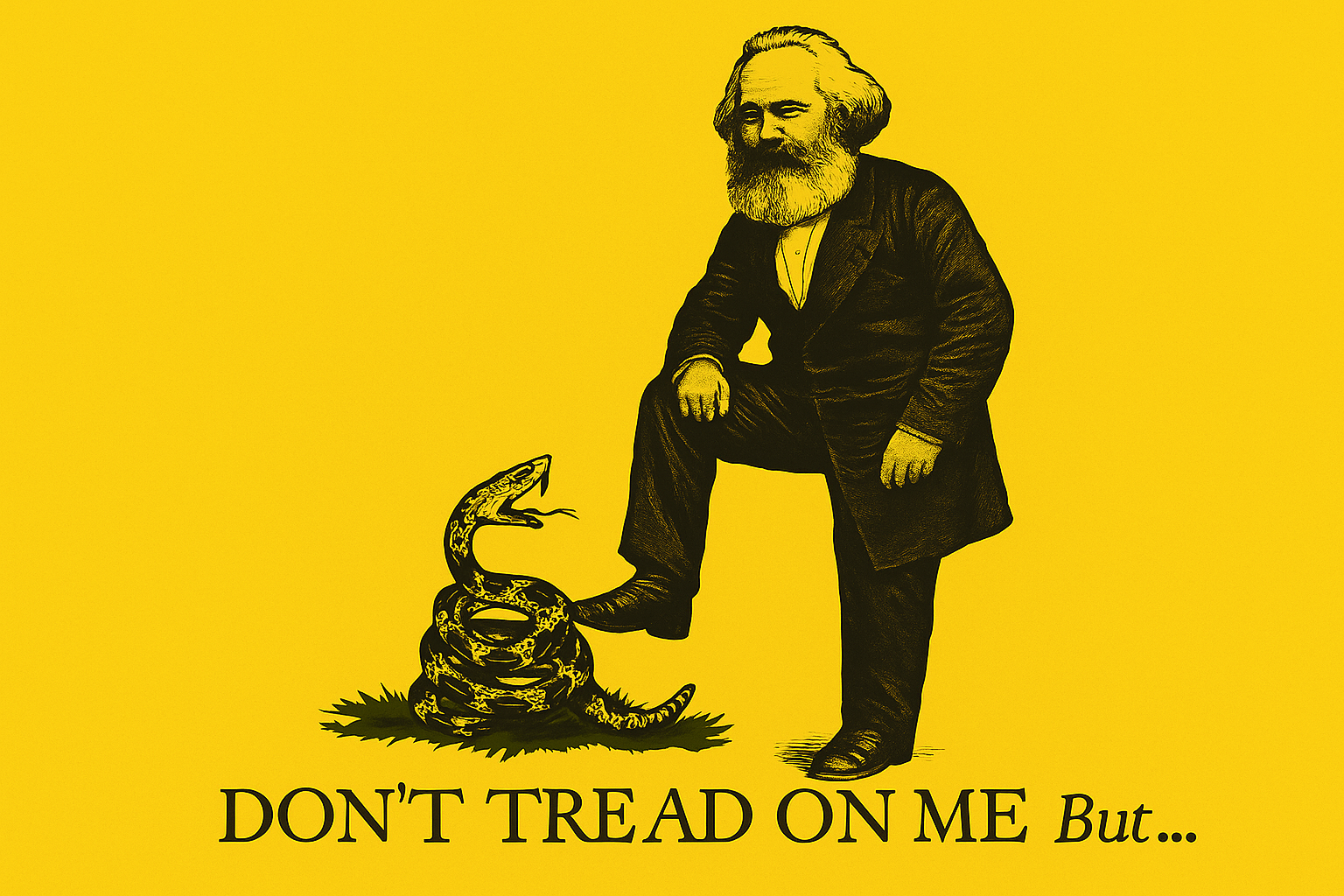
A strange trend has taken root within a portion of today’s anarcho-capitalist movement: some claim that the only “realistic” path to anarcho-capitalism is through an initial minarchist phase. According to this view, we must first shrink the state, then clean it up, then wait for private institutions to gradually outcompete its remaining functions until the state eventually “withers away.”
Nothing in this reasoning is libertarian.
In fact, it is a direct importation of Marxist historical materialism, repackaged under a pseudo-liberal label.
1. The parallel is obvious
liberal democracy → minarchy → anarcho-capitalism
is just feudalism → capitalism → socialism → communism
In Marxist theory, history follows a deterministic sequence:
feudalism → capitalism → socialism → communism.
The entire Marxian framework rests on the idea that history moves through objective stages, driven by internal forces, and that political actors exist merely to accelerate or facilitate that progression.
What do these “strategic minarchist ancaps” say?
“We must first achieve a minimal state, then the free market will naturally replace the rest, and eventually we will get full anarcho-capitalism.”
It is the same logic, the same teleology, the same historical determinism—simply inverted.
Instead of historical progress toward the abolition of private property, they propose historical progress toward the abolition of the state.
But the mechanism is identical:
a belief in necessary stages, a belief in political inevitability, and a belief in an almost scientific law of historical development.
This is not libertarianism.
It is Marxism with the polarity flipped.
2. Rothbard was explicit—these people are rejecting him outright
In “Do You Hate the State?”, Rothbard leaves no room for ambiguity:
If the Libertarian Party ever comes into power,
its first and only task is to abolish the state immediately.
Not gradually.
Not strategically.
Not through a “minimal” version of statehood.
Not by retooling the state into a more efficient machine.
Immediate abolition.
Full dismantling.
No transitional phases.
Why?
Because a “transition phase” requires conceding that the state is morally legitimate—at least in some limited form.
But once you concede that, you’ve already surrendered the argument.
If the state is a criminal institution, no version of it—whether micro-criminal or macro-criminal—deserves preservation for even a single day.
The “minarchist-first ancap” lives in a contradiction:
If the state is immoral, why preserve it at all?
If the state is a parasite, why keep a “small” parasite alive?
If the state is a gang, why keep a “minimal” gang on the payroll?
This logic is not libertarian.
It is a political version of the Marxist “historical phase” doctrine.
3. Hoppean “communities of convenience”: the soft neo-Marxism nobody wants to admit
The Marxoid contamination doesn’t stop at gradualism.
It also appears in the admiration some ancaps have for Hans-Hermann Hoppe.
Hoppe’s “communities of convenience” sound libertarian on the surface—voluntary associations, private law, contracts, exit rights.
But scratch the surface, and what do you find?
They are essentially closed communes, based on collective exclusion norms, uniformity, and group governance.
They depend on what is effectively a shared, quasi-collective property structure, enforced by group consensus.
If it looks like collectivism, functions like collectivism, and requires collectivist enforcement—
it is collectivism.
Hoppe merely replaces Marxist coercive collectivism with what he calls “voluntary collectivism,” but the structure remains:
- group-defined norms,
- group-defined membership,
- enforced homogeneity,
- and social order maintained through exclusion by a majority.
This isn’t anarcho-capitalism.
It is, at best, a rebranded form of collectivist anarchism, stripped of its honesty and dressed up as “order.”
4. The libertarian movement must purge its Marxist influence
The modern libertarian movement is suffering from an intellectual infection:
it has absorbed Marxist categories without realizing it.
This includes:
- the belief in historical stages,
- the belief in necessary progression toward an end-state,
- the belief in “transitional phases,”
- the belief in historical inevitability,
- and the belief that freedom is something that gradually emerges from political engineering.
This is Marxism, not libertarianism.
If libertarianism is to remain coherent, it must reject:
- any form of gradualism that mirrors Marxist dialectics,
- any framework that treats political change as a historical necessity,
- and any collectivist model disguised as “private governance.”
Libertarianism is Rothbardian at its core:
The state must be abolished—not improved, not optimized, not reformed.
Freedom does not grow in stages.
It is reclaimed in a single act—
or not at all.
Leave a Reply