
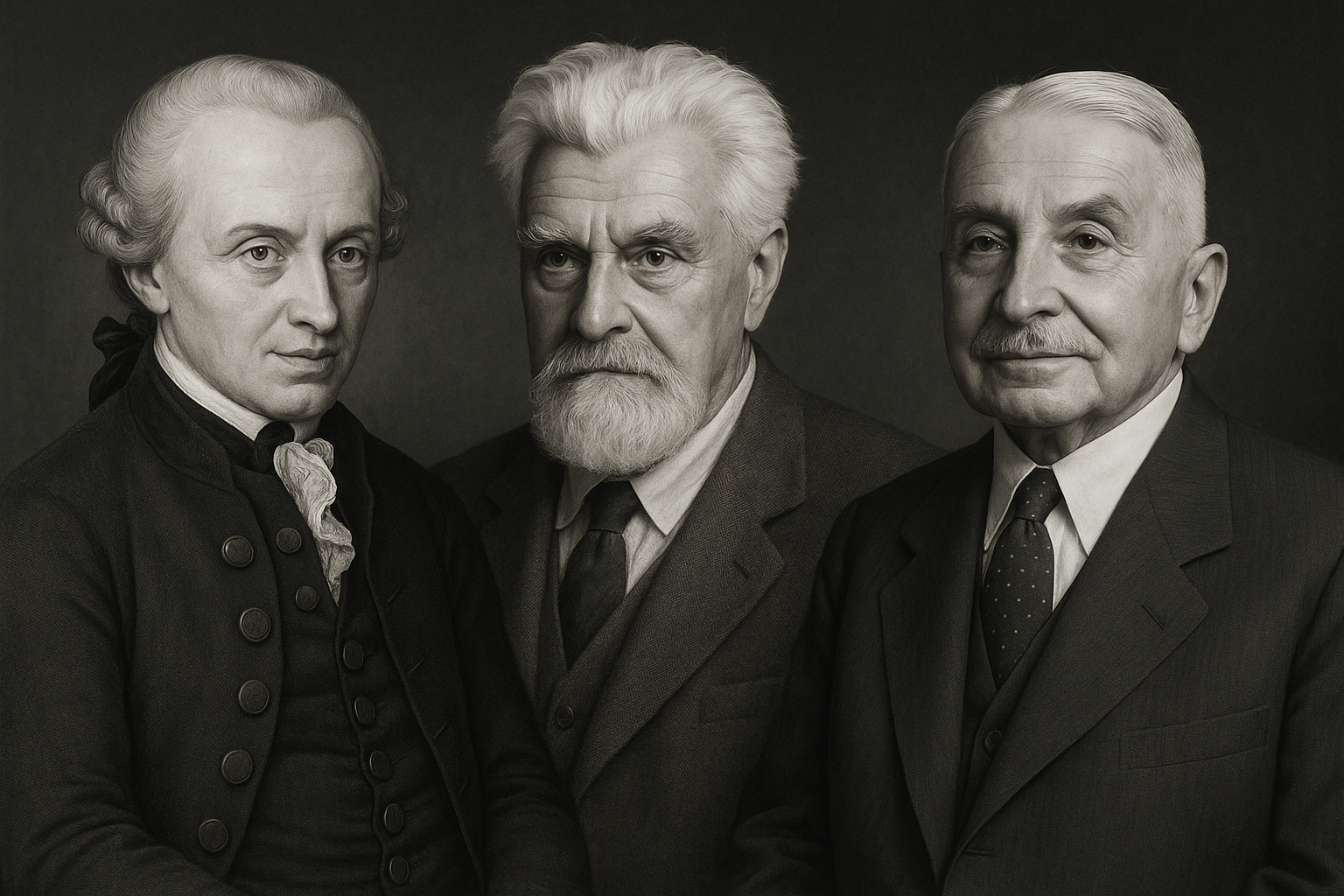
Apriorism, in its broadest sense, refers to the claim that certain truths can be known independently of experience. Yet beneath this general definition lies a profound philosophical divergence — between metaphysical apriorism, natural apriorism, and praxeological apriorism. Each represents a distinct approach to the problem of knowledge, the role of experience, and the nature of necessity. Understanding their differences reveals not only three visions of reason but also the philosophical foundations behind metaphysics, science, and economics.
1. Metaphysical Apriorism: Knowledge Rooted in Being
Metaphysical apriorism is the oldest and most ambitious form. It holds that reason can grasp truths about reality itself — the structure of being — independent of empirical observation. This tradition reaches from Plato’s theory of Forms to Leibniz’s rationalism, and even in part to Kant’s transcendental philosophy.
In this view, the a priori is ontological: it expresses necessary relations that exist in the structure of reality. Mathematics and logic, for instance, are not mere human inventions but reflections of eternal truths that condition all possible existence. For metaphysical apriorists, reason reveals what must be true in all possible worlds, not just what happens to be true in ours.
Critics, especially empiricists, object that metaphysical apriorism risks detaching thought from reality, turning reason into an autonomous abstraction. Yet for its defenders, without some form of metaphysical a priori, there would be no stable foundation for truth at all.
2. Natural Apriorism: The Biological Ground of Reason
Natural apriorism emerged later, particularly in the evolutionary and cognitive traditions, as a reaction against pure rationalism. It claims that our a priori categories — the structures through which we interpret the world — are not eternal truths but products of our natural constitution.
Thinkers like Konrad Lorenz argued that what seems “a priori” is rooted in the human way of being in the world. The mind’s forms of understanding are shaped by biology, evolution, and lived experience. Thus, the a priori becomes naturalized: it is prior to experience in the life of each individual, but posterior to experience in the history of the species.
Natural apriorism softens the dichotomy between reason and experience. It acknowledges the necessity of certain cognitive frameworks while grounding them in empirical, living reality. In short, our reason is both a condition for knowledge and a product of nature.
3. Praxeological Apriorism: The Logic of Human Action
Praxeological apriorism, developed by Ludwig von Mises and the Austrian School of Economics, takes a distinct path. It claims that certain truths — specifically about human action — are known a priori through reflection on the very concept of acting purposefully.
The fundamental axiom, “Man acts,” is not an empirical statement but a self-evident truth implied in the idea of purposeful behavior. From this axiom, praxeology deduces necessary propositions about choice, value, cost, time preference, and economic exchange. These are not contingent generalizations but logical implications of what it means to act.
Unlike metaphysical apriorism, praxeological apriorism does not seek to uncover the structure of all reality, only of human conduct. And unlike natural apriorism, it does not treat the a priori as an evolved cognitive trait but as a formal, conceptual truth that no possible experience could falsify.
For Mises, the praxeological a priori provides economics with the same certainty that logic provides mathematics: both are systems of necessary relations derived from undeniable premises.
4. Comparing the Three
| Aspect | Metaphysical Apriorism | Natural Apriorism | Praxeological Apriorism |
|---|---|---|---|
| Origin of the A Priori | Eternal structure of being | Biological and cognitive constitution | Conceptual structure of human action |
| Main Domain | Ontology and metaphysics | Epistemology and cognition | Economics and social science |
| Method | Rational intuition | Reflective empiricism | Logical deduction |
| Truth Status | Necessary and universal | Adaptive but stable | Necessary for any acting agent |
| Key Figures | Plato, Leibniz, Kant | Lorenz | Mises, Rothbard, Hoppe |
Leave a Reply